



On June 30, 2025, I published an interview with Lior Neumann, Augment Code’s team lead on Remote Agents. Asked about LLM costs for heavy usage, he said: “These numbers are going down super fast. So every time you think about a number, it’s probably not gonna stay the same three months from now.”
Sixteen months later, on list price, he was right. Anthropic’s pricing page still lists the retired Claude Opus 4 at $15 input and $75 output per million tokens. Opus 5.5 lists at $4 and $20, a 73% cut on both.
“Prices are falling” bundles two numbers.
Two Curves
The first is the price of a fixed capability. Hans Gundlach, Jayson Lynch, Matthias Mertens and Neil Thompson report that “the price for a given level of benchmark performance has decreased remarkably fast, around 5× to 10× per year, for frontier models on knowledge, reasoning, math, and software engineering benchmarks.” Epoch AI’s Luke Emberson and David Roodman put it higher: “The cost of achieving a given level of AI performance has fallen about 47% per quarter since 2023, or 13× per year.”
The second is the cost of the frontier. Gundlach’s team finds that “the price of running frontier models is rising between 3× to 18× per year due to bigger models and larger reasoning demands.” That measures what it costs to run benchmarks on the best models, not a per-token price. The race to the bottom is the first curve.
Extended, that curve takes a given capability toward costing very little. Both studies limit that projection. Gundlach’s team covers April 2024 to November 2025 on three benchmarks, at each model’s cheapest provider, fit to models on the cost-performance frontier. Counting every model cuts the decline by almost half. On SWE-bench Verified their confidence bounds are “consistent with there having been no progress at all.” Epoch’s three years of data are, by its authors’ account, “incomplete and noisy.” The decline also slows as a capability ages: 75x a year for performance that has just debuted as state of the art, 4.7x a year two years later.
The Bottom Moved
The cheap end hasn’t fallen everywhere. In August I wrote about a footnote on DeepSeek’s pricing page: “We plan to raise the overall pricing for DeepSeek API services in the near future, with a significant increase expected.” DeepSeek followed through. A Wayback capture from August 7 shows V4 Flash output at $0.28 per million tokens. On the current page, V4.1 Flash output costs $1.20 at peak hours, 4.3 times as much, and off-peak runs at half that. V4 Pro peak output went from $0.87 to $3.96. DeepSeek’s pages give no reason.
Google has increases scheduled. Gemini 4 Argon goes from $2 / $10 to $4 / $20 on December 1, and Gemini 3.8 Flash doubles on January 1.
Over the same three months, OpenAI’s GPT-6 Luna and Anthropic’s Claude Haiku 5.5 both landed at $0.10 input and $0.50 output. In June 2025 I predicted that Chinese open-weight models would set the price floor. Today the cheapest tiers from two US labs sit below DeepSeek’s.
Claude Fable 5.1 lists at $10 / $50, 100 times Haiku 5.5. GPT-6 Astra is 100 times Luna. Opus 5.5 is 40 times Haiku.
A Capability Gap That Depends on the Task
A 100x price gap would mean little if the models did the same work. They don’t. To keep one pair throughout, I used Artificial Analysis’s comparison of Haiku 5.5 at its High setting against Fable 5.1 at Xhigh, on AA’s Intelligence Index v5.0 as of November 3. Haiku scores 30 and Fable 50. Benchmark by benchmark, the gap runs from 9 points on GDP.pdf (17% against 26%) to 35 points on HLE-Diamond (24% against 59%).
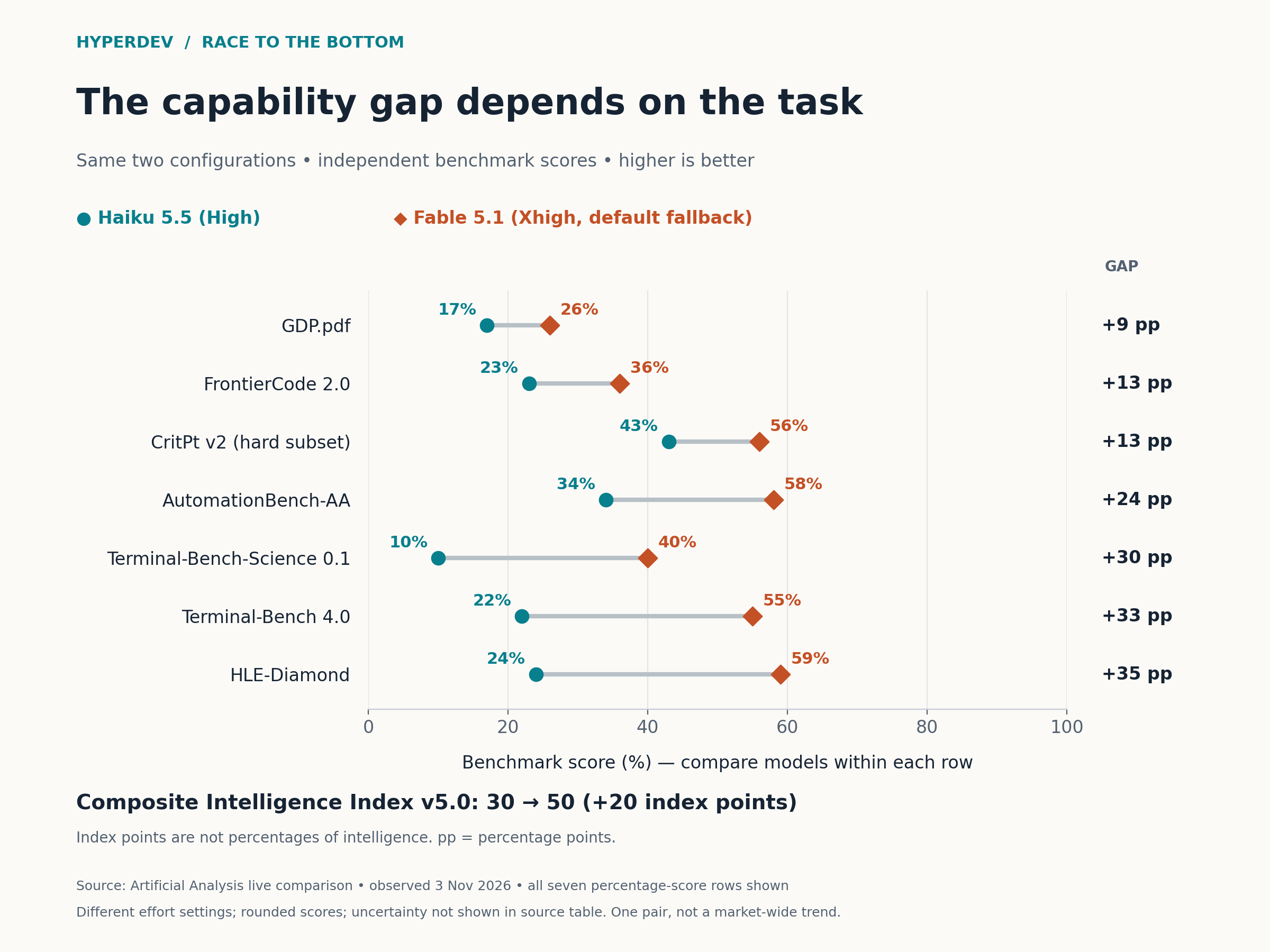
The pair shows price extremes, not capability extremes: Opus 5.5 at Max outscores Fable, 58.4 on the same index.
On the wider leaderboard, cheap models come close on some work and fall well short on other work. On AutomationBench, DeepSeek V4.1 Flash scores 0.666 against Opus 5.5’s 0.695. On Terminal-Bench 4.0, an agentic coding test, GPT-6 Luna scores 0.126 against Opus 5.5’s 0.596. Vendors report different numbers under the same benchmark names: Anthropic reports 39.2% for Haiku 5.5 on Terminal-Bench 4.0, where AA measures 32.8% at Max. I use AA’s November 3 figures throughout, because leaderboard numbers move.
Today’s Worked Cost
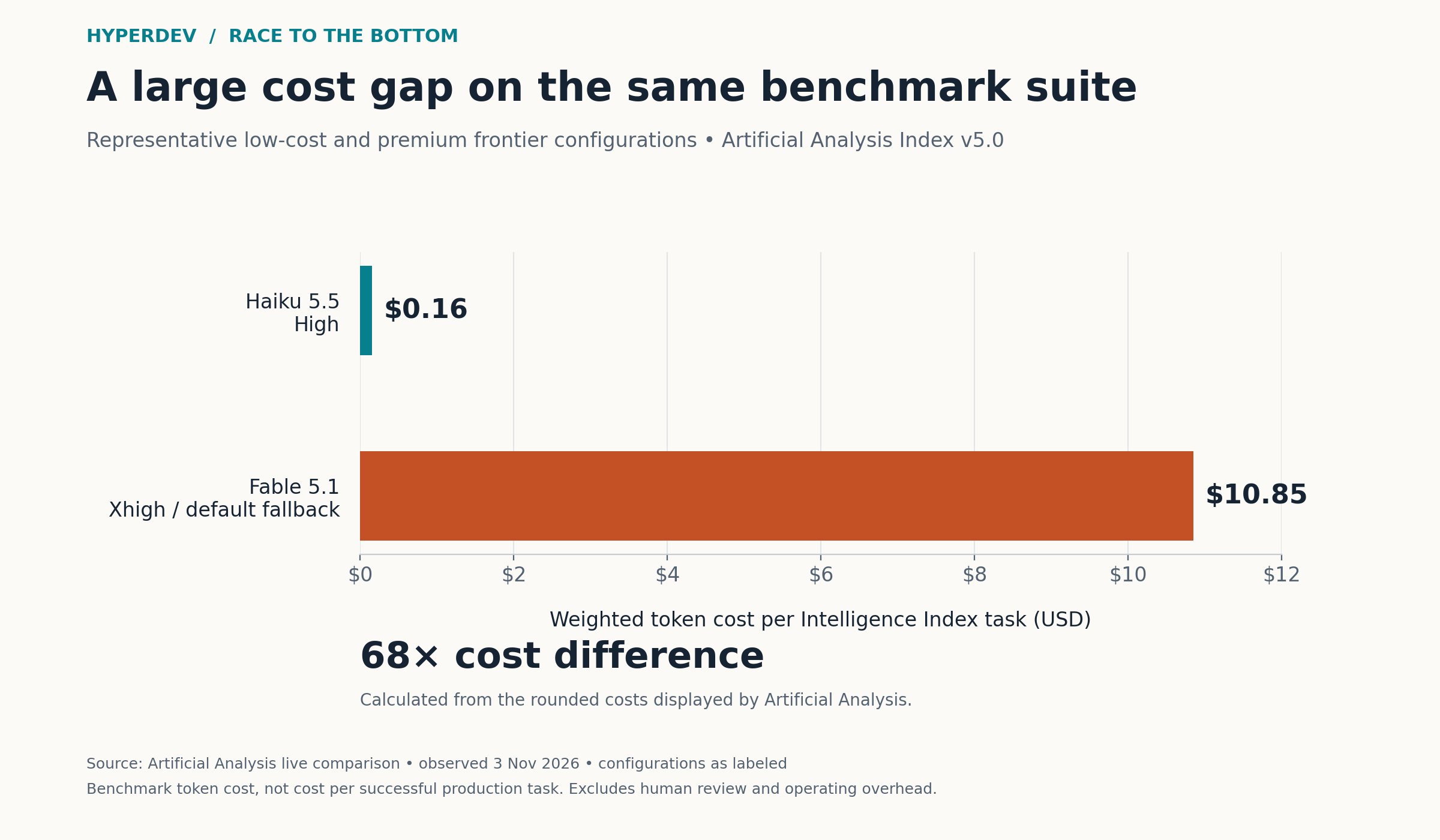
On that observed benchmark cost, Haiku 5.5 runs $0.16 per task and Fable 5.1 costs $10.85, 68 times as much. Output tokens per task are close, 88,000 against 97,000, so most of the gap is price. A low token price doesn’t guarantee a low task price, though. Gemini 3.8 Flash at High costs $7.77 per AA task, about the same as Gemini 4 Carbon ($7.76) at the top of the leaderboard.
I priced four workloads at today’s list prices. The token counts, retry rates, thinking overhead and review shares are illustrative assumptions, not measurements.
Ticket triage. Classifying 100,000 support tickets, at 2,000 tokens in and 200 out each, costs $30 on Haiku 5.5 or Luna ($15 in batch), $1,200 on Opus 5.5 and $3,000 on Fable 5.1. Assumed overhead: 500 thinking tokens per call, retries on 1% of frontier calls and 3% of cheap ones, and a person spot-checking 2% of frontier output and 5% of cheap output at 30 seconds a ticket. At the BLS median of $21.53 an hour for customer service representatives, Haiku 5.5 comes to $45.53 in tokens and $897.08 in review. Opus 5.5 totals $2,120.27. The cheap model wins, and review costs about 20 times its token bill.
Summaries. Summarizing 10,000 ten-page documents costs $10.50 on Haiku 5.5, $5.25 in batch. A summary has no automatic check. If an editor reads 1% at three minutes each, review costs $107.65, 10 to 20 times the model run.
Nightly extraction. Pulling fields from 50,000 records a night costs $7.50 in batch on Haiku or Luna, $2,738 a year. Fable or Astra costs $750 a night, $273,750 a year. A 1% human audit at a minute per record costs $179 a night, more than any cheap model’s run.
Agentic coding. Here the winner depends on who catches failures. My assumed attempt runs 30 tool turns on a frontier model and 45 on a cheap one, with context growing each turn and output multiplied by 2.5 for thinking tokens. Tokens per attempt cost $1.09 on Opus 5.5 and $0.128 on Haiku 5.5. For success rates I borrowed each model’s AA Terminal-Bench 4.0 score and treated attempts as independent, a proxy rather than a measurement of this task. Review is 15 minutes of developer time, $16.11 at the BLS median for software developers and testers. If tests reject failed attempts and a person reviews only the one that passes, Haiku costs $16.62 per accepted task against Opus’s $18.84. If a person reviews every attempt, Haiku costs $49.62 and Opus $29.76.
In 2021, the best published code model, Codex, solved 28.8% of HumanEval’s single-function problems. Today a multi-file attempt costs $0.04 to $3.44 in tokens, and the review costs more.
None of these token bills is zero. They’re small next to the review lines, and still money on an invoice.
What Five Years Ago Couldn’t Afford
In December 2021, OpenAI charged $0.06 per thousand tokens for Davinci. The same 100,000-ticket run would have cost $13,200, and each 2,200-token call exceeded GPT-3’s 2,048-token context window. A 100-page contract, about 50,000 tokens, would have needed 25 or more chunks. OpenAI’s September 2021 book-summarization work shows the method: the model “first summarizes small sections of the book and then recursively summarizes these summaries.” Today the contract fits in one Haiku 5.5 call for about half a cent. The nightly extraction would have cost $5,400 a night on Davinci.
Not every gap is that wide. Transcribing 1,000 hours of calls on Google Speech-to-Text cost about $1,440 in 2021. Gemini 3.5 Transcribe, with speaker diarization, runs about $300, roughly 4.8 times cheaper. Extracting fields from a million photographed invoices on Gemini 3.5 Flash-Lite costs $777 to $1,554, close to what 2021 document text detection cost per page. That 2021 price bought the page’s text. Today’s buys the fields. Tokenizers differ between 2021 and now, so read these comparisons as orders of magnitude.
Judgment and Integration Become the Bottleneck
In every workload I priced, under my assumed review shares, human review cost more than the cheap model’s tokens. Teams that check output with machines (tests, schema validation, deterministic routers) get the falling curve. Teams that need a person to look at every result are paying for judgment, and there a frontier model can come out cheaper.
I’d route by task: deterministic code where a rule or parser does the job, a cheap model for high-volume work a machine can check, and a frontier model where failures are expensive to catch. My judgment, from the coding example, is that integration becomes the constraint: the harnesses, validators and routers that let a machine reject bad output. There, tests rejecting failed attempts are what let Haiku beat Opus.
The cheapest option in the ticket workload isn’t a model. A keyword router that labels password resets and refund-status tickets, run on AWS Lambda at 50 milliseconds and 512 MB per call, costs about six cents for 100,000 invocations before the free tier. That’s roughly 500 times less than the $30 cheap-model run, with the same label every time. It can’t read free text, and the cheap model is less reliable than either the rule or the frontier model. I expect we will be seeing many of these types of workflows run on classification/decision models like Jev going forward.
Bob Matsuoka is CTO of Duetto, a hospitality profit and revenue-management platform.
Related Reading:
The Cheap Model Blinked First. DeepSeek’s warning of a significant price increase, and what it did to my price-floor prediction
Why Augment Code Is Betting Beyond the IDE. The interview where Lior Neumann said prices wouldn’t hold for three months
The Other Shoe Will Drop. My June 2025 prediction that Chinese open-weight models would set the price floor
I Tracked Every Token. Why cost per task tells you more than cost per token
AI Power Ranking. Tool comparisons and benchmarks for AI practitioners
LinkedIn Newsletter. Strategic AI insights for CTOs and engineering leaders