

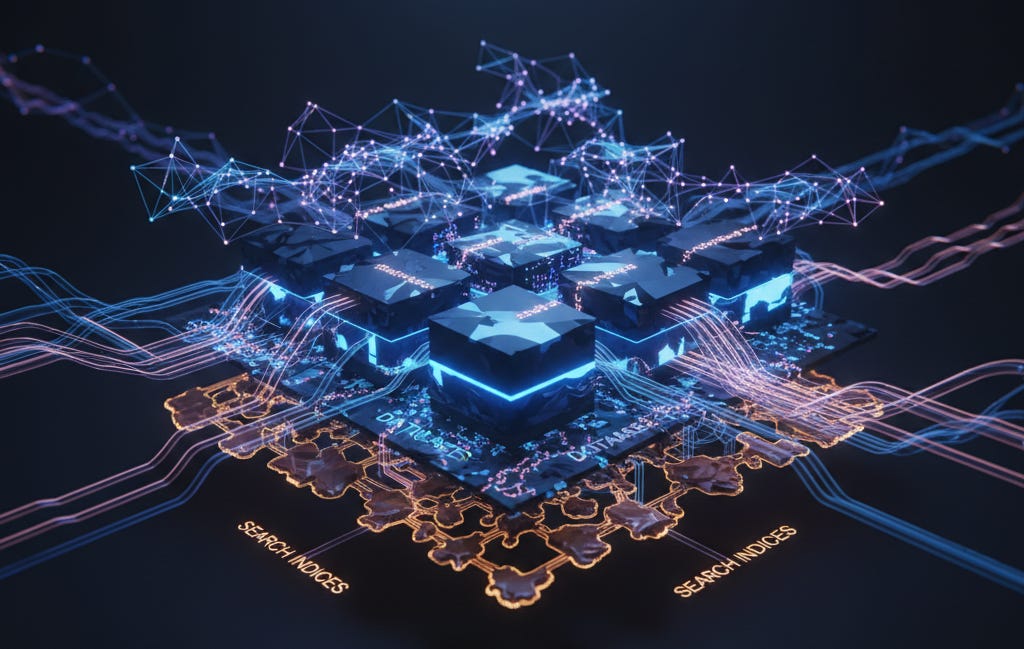
The modern CTO toolkit isn’t just apps and coding tools. The real differentiator is a custom knowledge layer — databases, search indices, memory graphs, behavioral instructions that compound over time. No product gives you this. You build it.
Andrej Karpathy gestured at something similar last month when he posted a GitHub Gist he called “LLM Wiki.” His framing: stop using LLMs just to write code, use them to build and maintain a personal knowledge base instead. “Obsidian is the IDE, the LLM is the programmer, the wiki is the codebase.” Three folders, structured Markdown, a large context window, a few Python scripts. No RAG, no vector database. He concluded with: “I think there is room here for an incredible new product.”
He’s right that there’s room. But the product comment is where I’d push back, and I’ll get to that. What Karpathy is describing isn’t a note-taking system. It’s a personal operational knowledge layer. For CTOs specifically, that layer needs to be broader than a personal wiki — it needs live organizational data, agent-connected search, and context that persists across months of decisions. No app hands you that.
TL;DR
Karpathy’s LLM Wiki shows the direction: LLMs as knowledge compilers, not just code generators
A modern CTO’s “second brain” is more than PKM — it’s live databases, custom agents, and contextual search across organizational data
When I joined Duetto as CTO, my custom toolkit let me synthesize a 150-person R&D org in weeks instead of months
The power isn’t Obsidian. It’s what you connect to it — MCP servers, search indices, knowledge graphs
Productizing this is theoretically possible and practically very hard, because the schema is the moat
The toolkit article got it half right
In What’s In My Toolkit: Claude Code and Family, I wrote about vanilla Claude Code’s core limitations: context evaporates, code search is keyword-based, memory doesn’t persist, execution is single-threaded. The tools I built — Claude MPM, mcp-vector-search, kuzu-memory — address each of those gaps.
But that article was about coding workflows. The real story is broader.
The same architecture that makes a coding session more effective — persistent memory, semantic search, specialized agents pulling from structured data — turns out to be extraordinarily useful for executive work. Understanding an organization, tracking decisions over time, querying data across systems, maintaining context across months of meetings and analysis. The toolkit I built for software development became the toolkit I used to onboard as a CTO.
That onboarding story is documented in detail elsewhere. Short version: I pointed a multi-agent framework at GitHub, JIRA, Slack, Confluence, and budget spreadsheets, and synthesized a 150-person R&D organization in the weeks before my start date. The difference between doing that with a chat interface versus a CLI-based orchestration layer with parallel agents and persistent memory wasn’t 2x or 5x. It was closer to 10x.
But the onboarding was just the starting gun. The second brain I assembled keeps compounding.
What’s actually in my second brain
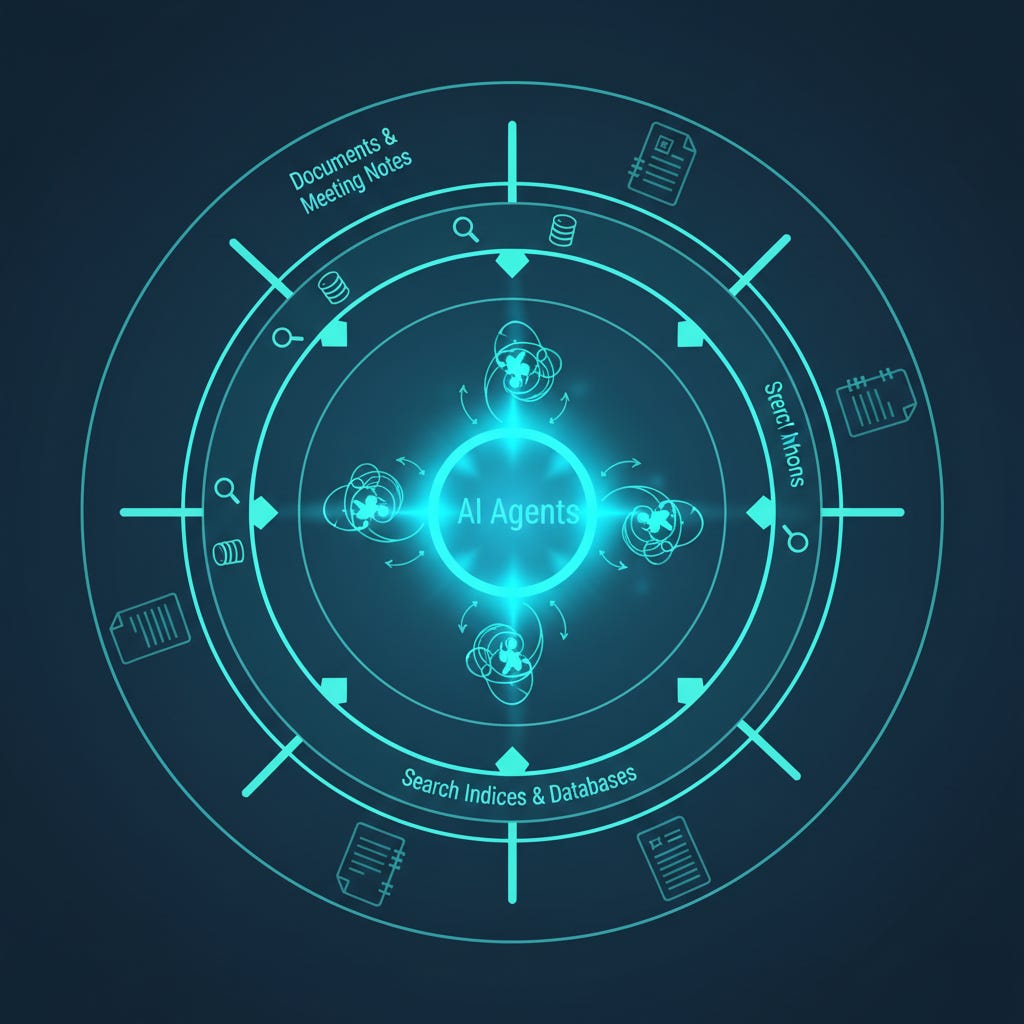
Let me be specific. Because when people (now) hear “second brain” they usually think Obsidian vaults with color-coded tags and pretty Markdown files. That’s part of it. It’s the surface layer.
The actual power comes from what’s underneath.
The memory layer
kuzu-memory is a KuzuDB-backed knowledge graph that persists across every AI session. It stores learnings from conversations, code commits, decisions, patterns. When I start a new Claude Code session on a problem I’ve touched before, the context isn’t blank — it’s enriched with what was learned the last time.
This is the thing people underestimate. A project-specific memory that accumulates over months of work develops a kind of organizational intelligence you can’t replicate in a single conversation. It knows why a particular architectural decision was made. It knows that a vendor was evaluated and found lacking. It knows the terminology your team uses internally that differs from industry standard.
KuzuDB isn’t a product choice for its own sake — it’s graph-native, which means it handles relationships well. The connections between people, systems, decisions, and code are as important as the facts themselves.
The search layer
mcp-vector-search provides semantic search across all project files. Not keyword search — semantic search with AST parsing. When I ask “where is the analysis I did on contractor productivity last quarter,” it finds it even if the document never uses those exact words.
At Duetto, this covers everything in my CTO project: architecture records, meeting notes pulled from Granola, emails I’ve synthesized, analysis documents, planning artifacts. Months of accumulated context, all searchable in seconds. The underlying code intelligence for the engineering organization runs as a separate service — mcp-vector-search is for my working knowledge, not the codebase itself.
The databases
My CTO project has three:
cto.db — SQLite. Work classification, people analysis, contributor data, commit history. The operational database for running analyses and reports.
analytics.duckdb — DuckDB. OLAP queries and analytics. When I need to slice engineering output data in different ways or run something that would be painful in SQLite, it goes here.
duetto_knowledge.db — The RAG-queryable knowledge base backing a Flask web app for interactive exploration.
These aren’t a product I bought. They’re a schema I designed, built incrementally, and own completely. The schema reflects how I think about the organization, which is precisely why it’s useful.
The connectors
gworkspace-mcp handles Drive, Docs, Sheets, Gmail, Calendar, and more. I wrote my own rather than using the off-the-shelf options — Google’s first-party integration and Anthropic’s default both have significant tool coverage gaps. Mine exposes substantially more of the Workspace API surface and integrates transparently with Claude MPM, so agents can use Google Workspace tools without any special configuration at the call site.
Beyond Workspace: Notion API for product specs and planning documents. Extraction scripts for JIRA, Confluence, Slack, Datadog, and AWS. Each system outputs to as raw data, which feeds analysis pipelines that generate reports stored in a project directory.
For company-wide memory, two more tools: duetto-memory and duetto-directory. These handle shared organizational context — information that needs to flow between tools and across team members rather than staying in a single session. Memory persists within our VPC, encrypted to individual users’ OAuth keys. Not even our own IT has access to it. Context shared from Claude Code shows up in Claude.ai, and vice versa, without any manual sync.
The entire flow is queryable. From a single Claude session, I can ask about budget trends, team velocity, specific architectural decisions, or what a particular engineer has been working on for the last three months. Because it’s all in the same context-addressable system.
Obsidian as the front door
Yes, I use Obsidian. But it’s a front door, not the building. The vault holds my personal notes, research captures, and synthesized analysis. The Obsidian Web Clipper feeds raw material into the knowledge pipeline. Templates enforce consistent structure.
Karpathy’s insight about Obsidian as IDE is right in the narrow sense: it’s the interface you use to read and organize. But the interesting work happens outside it — in the databases, the agents, the search indices, the custom scripts.
CLAUDE.md files everywhere
The context layer isn’t just data. It’s also behavioral instructions.
Every major directory in my project has a CLAUDE.md. The root CTO project one is 400 lines of conventions, routing logic, document lifecycle rules, and architectural decisions. Every subdirectory has a more focused version. Every specialized agent has its own constraints.
These files are my second brain’s schema, expressed as instructions rather than data. A single routing rule — “if the prompt mentions meeting notes, save to projects/meetings/2026-W##/“ — sounds trivial. But it means twelve months of meeting notes accumulate in consistent, queryable locations rather than wherever an agent happened to save them. Multiply that by forty routing rules across fifteen subdirectories, and the entire corpus becomes navigable. The CLAUDE.md files are what make the databases useful. Without them, the data is just data.
Karpathy put it well: “You share the schema, not the code.” The schema is the valuable part. The schema is what compounds.
My schema took months to build. It will keep getting better. No product ships with the right schema for my organization, because no product knows what I know about how Duetto’s R&D works.
The productization question
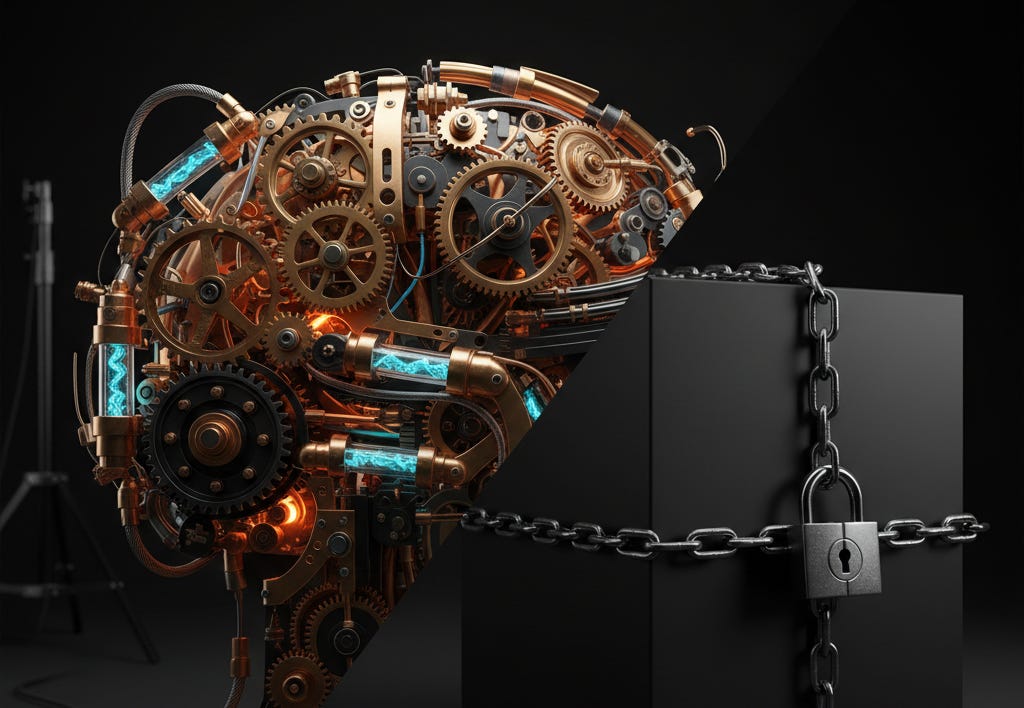
Karpathy said there’s room for an incredible product. He’s not wrong about the gap. He might be wrong about the solution.
The structural problems with productizing a second brain:
Context compounds, products don’t. My system gets smarter with every commit, meeting, and conversation. A SaaS product serves thousands of customers and maintains no one’s specific context. The more I use my system, the wider the gap between it and any off-the-shelf alternative.
The schema is the moat. My knowledge architecture reflects how I think about engineering organizations. Someone else’s knowledge architecture would be different. Products that force their schema on you — and every product does — are imposing someone else’s way of thinking on your problem. That friction is small at first and grows over time.
Privacy is structural, not incidental. My databases contain org structures, salary data, performance patterns, vendor negotiations. Routing that through third-party infrastructure creates risk that’s practically impossible to contain. When I built duetto-memory for enterprise use, the entire stack stays within our VPC, with memories encrypted to individual users’ OAuth keys. Not even IT can read them. That level of isolation is nearly impossible to provide as a multi-tenant SaaS.
Some layers could be productized — the infrastructure, not the intelligence. A well-designed memory MCP with sensible defaults. Semantic search that works without configuration. Privacy-preserving graph storage you don’t have to host yourself. The plumbing.
The schema, the decisions, and the accumulated context can’t be productized. Those are yours. That’s the point — and it’s also why the product gap Karpathy sees will remain open even after someone tries to fill it.
Can anyone do this?
There’s an access problem here, and I’d be dishonest not to acknowledge it.
Building what I’ve described requires knowing Python well enough to write extraction scripts, understanding enough about graph databases to design a schema, and being comfortable with CLI-based tooling and MCP server configuration. Not every CTO has that background. Not every technical leader wants to spend weekends building personal infrastructure.
The irony is that the people who most need better organizational intelligence — executives without deep engineering backgrounds — are least equipped to build these systems. And the people who are most capable of building them are often less interested in the executive problems the systems could solve.
Tiago Forte, who wrote Building a Second Brain, has been making this point for years. His PARA method and CODE framework are accessibility layers — ways to make the underlying ideas approachable without requiring you to build a graph database. The methodology is sound. But it was designed for knowledge workers, not for CTOs running engineering organizations who need live data pipelines, not filing systems. Well-designed for whom?
Karpathy’s LLM Wiki is explicitly a system for someone comfortable writing Python and working with file systems. His Gist has code in it. That’s a feature for his audience and a barrier for everyone else.
What I’d watch for
A few trends that will determine whether this remains a DIY space or gets productized:
MCP as infrastructure. The Model Context Protocol creates a standard interface for exactly this kind of knowledge infrastructure. Memory servers, search servers, database connectors — they all expose the same interface to any compatible AI client. The ecosystem is growing fast. As more MCP servers mature, the configuration burden drops.
Searchable context beats raw window size. Karpathy argues for plain Markdown because ~400K words fit in a modern context window. That’s true, and the window is getting larger. But the more important shift is that structured, searchable context doesn’t have a ceiling. A well-organized knowledge base that spans years of meetings, decisions, and analysis delivers more than any single context window can hold — and the value scales with the quality of the organization, not the size of the model.
Local model quality. Karpathy runs Anthropic agents via Claude Code. But local model quality is improving fast. A system that uses the cloud API for synthesis and queries but runs a local model for routine indexing tasks would be significantly cheaper and more private. Not ready yet. Getting closer.
The product Karpathy thinks exists — if it gets built — probably looks like a well-designed local MCP server with clean configuration, sensible defaults, and a plugin ecosystem for connectors. Not a SaaS. Not a cloud database. Something you install and own.
The people who need it most will have already built their own before any product ships. And in the process of building it, they’ll have accumulated the one thing no product can give them: months of their own operational context, organized the way their own mind works.
That’s not a consolation prize. That’s the whole point.
Bob Matsuoka is CTO of Duetto and writes about AI-powered engineering at HyperDev.
Related reading:
What’s In My Toolkit: Claude Code and Family — The coding layer of the stack
I Built a Coding Tool. Then I Used It to Onboard as CTO — Applying agent orchestration to organizational analysis
AI Power Ranking — Tool comparisons and benchmarks for AI practitioners
LinkedIn Newsletter — Strategic AI insights for CTOs and engineering leaders