


TL;DR
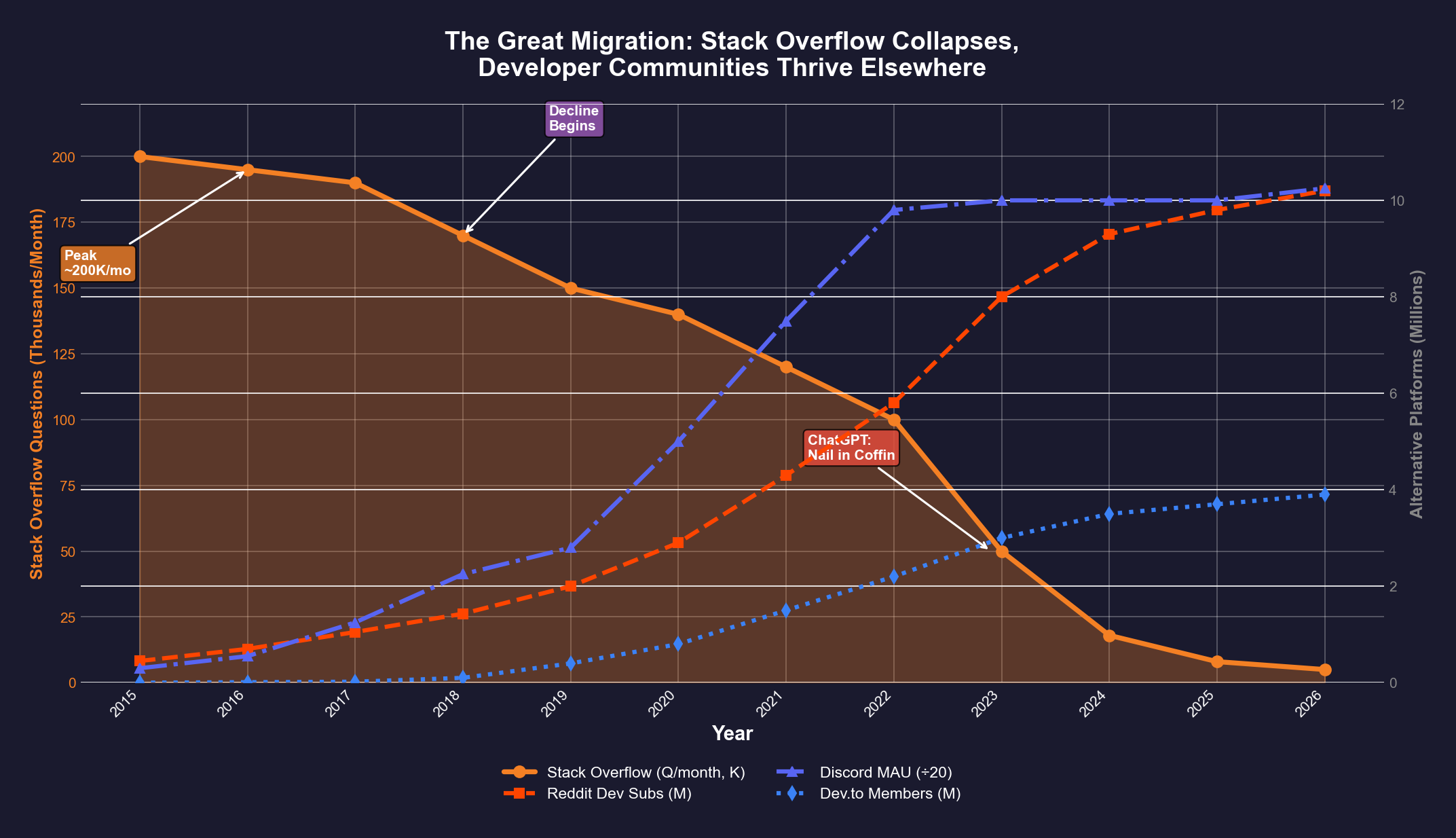
Stack Overflow’s question volume collapsed ~95% from peak—back to 2008 levels. Traffic down ~75%. The archive remains valuable; new contributions have largely stopped.
The decline started in 2018—four years before ChatGPT. The model was already broken; AI accelerated an existing trend.
Developers didn’t stop communicating—they migrated to Reddit, Discord, Dev.to, and AI tools. r/programming has 5-6 million members; Discord has 200M+ monthly active users.
The key insight: Stack Overflow optimized for definitive answers—exactly what LLMs do well. Reddit/Discord provide discussion, opinion, validation—what LLMs struggle with.
Transactional Q&A platforms are vulnerable. Community-first platforms are thriving. This is unbundling, not death.
Stack Overflow still gets read. But it stopped getting written.
Question volume has collapsed from 200,000/month at peak to under 10,000 today—a 95% drop. That’s not a community fading, it’s a Q&A product being outcompeted.
Peter Coy wrote a piece in the New York Times recently arguing this signals the end of developer knowledge-sharing. Developers used to share publicly; now they ask ChatGPT privately. “A little sad,” he called it.
I think Coy has it backwards. Developers aren’t talking less—they’re talking elsewhere. The activity migrated to Reddit, Discord, and AI tools. Stack Overflow’s death isn’t about lost community. It’s about an obsolete model being replaced by better ones.
The collapse is real
Let me be clear: Stack Overflow really is dying. By “dying” I mean new contributions—questions, answers, edits—have collapsed. The archive remains; the community doesn’t.
The numbers are stark. Traffic has collapsed roughly 75% from peak, according to third-party analyses like ByteIota (based on SimilarWeb estimates). Question volume tells an even starker story: Stack Exchange Data Explorer queries show monthly questions dropping from ~200,000 at the 2014-2017 peak to under 10,000 by late 2025. That’s back to 2008 levels—the site’s launch year.
I used Stack Overflow heavily for years. Seeing activity fall back to early-2008 levels is hard to overstate.
Fifteen years of growth erased in under three years.
The paradox is that 84% of developers still browse Stack Overflow. The archive has value. But almost nobody contributes anymore. The site has become a museum—visited, but not lived in.
Where developers went
Here’s what the “developers stopped talking” narrative misses: they moved.
Reddit exploded. r/programming has somewhere between 5-6 million members. r/learnprogramming has around 4 million. Both subreddits are trending at over 1,000% on growth metrics, adding thousands of subscribers daily. These aren’t ghost towns—they’re thriving.
Discord expanded far beyond gaming. The service now has over 200 million monthly active users, and developer communities have exploded. Reactiflux (the React community) has 230,000+ members. Python Discord, Rust Discord, and dozens of framework-specific servers have become the default place for real-time developer discussion.
Dev.to grew to millions of members. Built on community-first principles with lower barriers to participation than Stack Overflow ever had.
The MCP ecosystem exploded. MCP—the Model Context Protocol—lets AI assistants call external tools: APIs, databases, services. Think of it as giving Claude or ChatGPT hands instead of just a mouth. In November 2024, there were maybe 100 MCP servers. By February 2026, over 17,000. A new form of executable knowledge-sharing emerged in the time it took Stack Overflow to collapse.
Developers didn’t stop communicating. They stopped using Stack Overflow.
Why Reddit thrives while Stack Overflow dies
Here’s a clarifying question: if LLMs killed Stack Overflow, why didn’t they kill Reddit?
The answer reveals the real dynamic at play.
Stack Overflow optimized for definitive answers. One question, one accepted answer, close the duplicates, move on. The entire system was designed to produce canonical, searchable, authoritative responses to technical questions.
That’s exactly what LLMs do. Better. Faster. Without the closure votes and downvotes.
Reddit optimizes for discussion. There’s no “accepted answer.” The same question can be asked repeatedly without getting closed. People share opinions, debate tradeoffs, validate frustrations, and build community around shared interests.
LLMs struggle with that. Try asking Claude or ChatGPT “Is this framework actually good or does it just have good marketing?” You’ll get a balanced, diplomatic non-answer. Ask Reddit and you’ll get thirty developers telling you exactly what they think, with war stories and receipts.
Factor Stack Overflow Reddit Content model Q&A with “correct” answers Discussion threads Duplicate policy Aggressively closed Tolerated, repeated Reputation system High-stakes rep + privileges Lighter-touch karma Engagement type Transactional (get answer, leave) Conversational (participate, stay) AI competition Direct replacement Complementary
The “site:reddit.com” phenomenon tells the story. Users increasingly append that modifier to Google searches specifically because they want human perspectives, not AI-generated summaries or SEO-optimized content farms. They’re actively seeking out the thing LLMs can’t easily provide.
Stack Overflow competed with AI on AI’s home turf. Reddit doesn’t.
Why developers didn’t fight for it
The product model explains the competitive pressure. But the culture explains why developers didn’t fight to save it.
Stack Overflow’s culture was broken long before ChatGPT arrived. Look at the question volume data: the decline started in 2018—four full years before ChatGPT launched. Monthly questions dropped from 200,000 to 140,000 before GPT-3’s 2020 release, and well before ChatGPT’s late 2022 launch. The trajectory was already set.
ChatGPT didn’t kill Stack Overflow. It was the final nail in the coffin.
In 2019, Stack Overflow surveyed its own community about a much-publicized initiative to improve culture. Seventy-three percent of respondents said the site remained “equally unwelcoming” compared to before the initiative. This wasn’t outside criticism—it was the community itself acknowledging the problem hadn’t been fixed.
Anyone who’s used the site knows what this looked like in practice. You’d ask a question, spend twenty minutes crafting it carefully, and within seconds someone would mark it as a duplicate of a vaguely related question from 2014. Or close it as “not a real question.” Or downvote it without explanation.
The reputation system created perverse incentives. High-rep users had the power to close questions, and the system rewarded fast closure and strict gatekeeping over patient explanation. New users learned quickly that asking questions was a minefield. The site optimized for the archive, not for learning.
Public disputes between moderators and leadership became common. Several moderators resigned, citing disagreements over governance and feeling unsupported by the company.
To be clear: Stack Overflow did things well. The archive is genuinely valuable—24 million questions and answers representing collective knowledge. Discoverability was excellent. The structured Q&A format created stable, linkable URLs. Canonical answers for common problems saved countless hours.
But the community that created those answers? That was poisoned years ago.
LLMs didn’t kill Stack Overflow. They just offered developers an alternative that didn’t make them feel stupid for asking questions.
What happened to everyone else
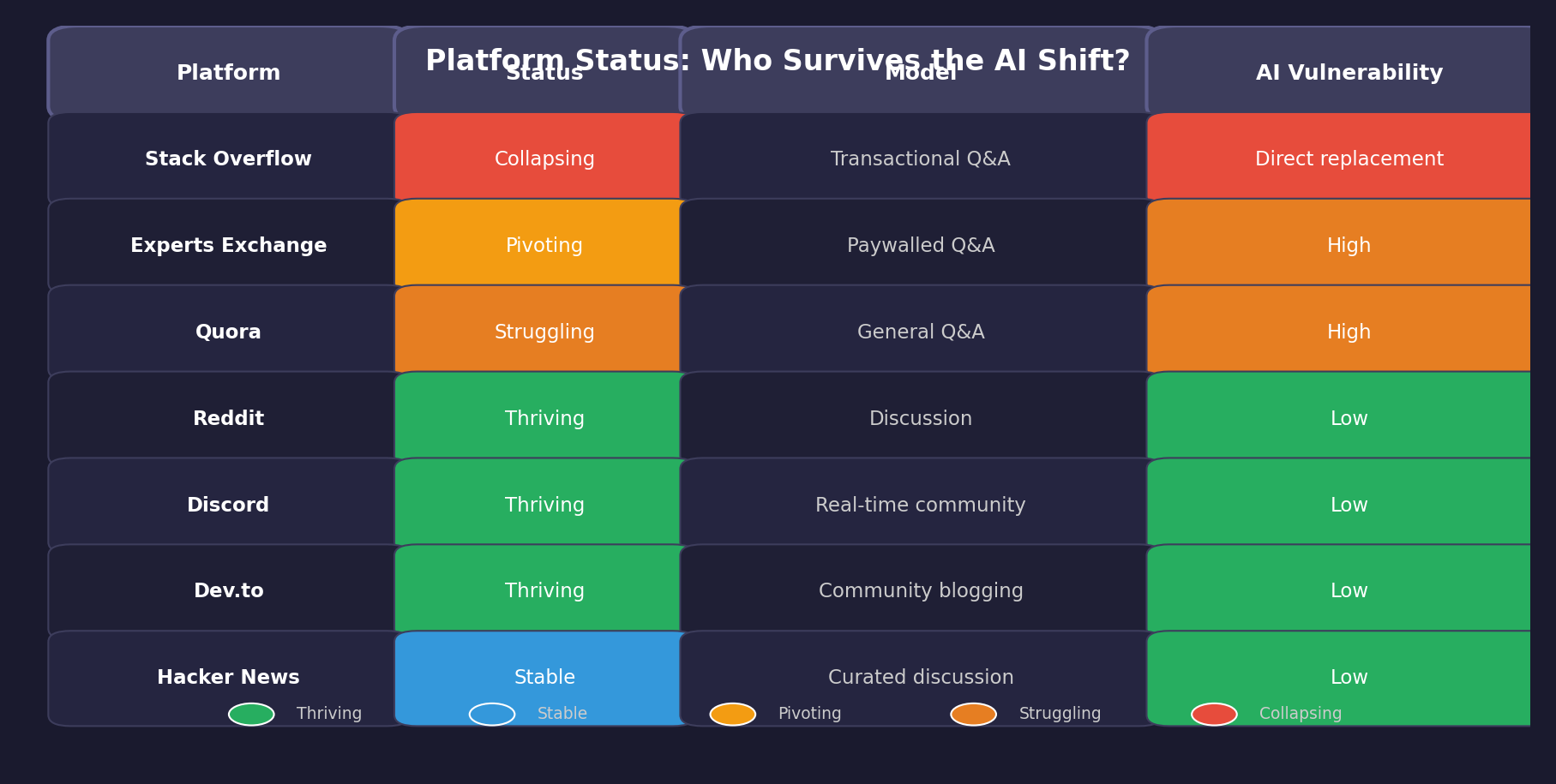
Stack Overflow isn’t the only platform affected by this shift. Here are some others:
Platform Status Model AI Vulnerability Stack Overflow Collapsing Transactional Q&A Direct replacement Experts Exchange Pivoting Paywalled Q&A High Quora Struggling General Q&A High Reddit Thriving Discussion Low Discord Thriving Real-time community Low Dev.to Thriving Community blogging Low Hacker News Stable Curated discussion Low
Experts Exchange pivoted hard. Remember them? The original “answers behind a paywall” site that Stack Overflow was created to replace? They’re still around, now positioning themselves as “the home of human intelligence.” The anti-AI angle is their entire pitch now.
The pattern: community-first platforms survive. Transactional Q&A platforms are vulnerable. If your model is “user asks question, platform provides answer,” you’re competing directly with AI. If your model is “users discuss, debate, and build relationships,” you’re not.
The new knowledge architecture
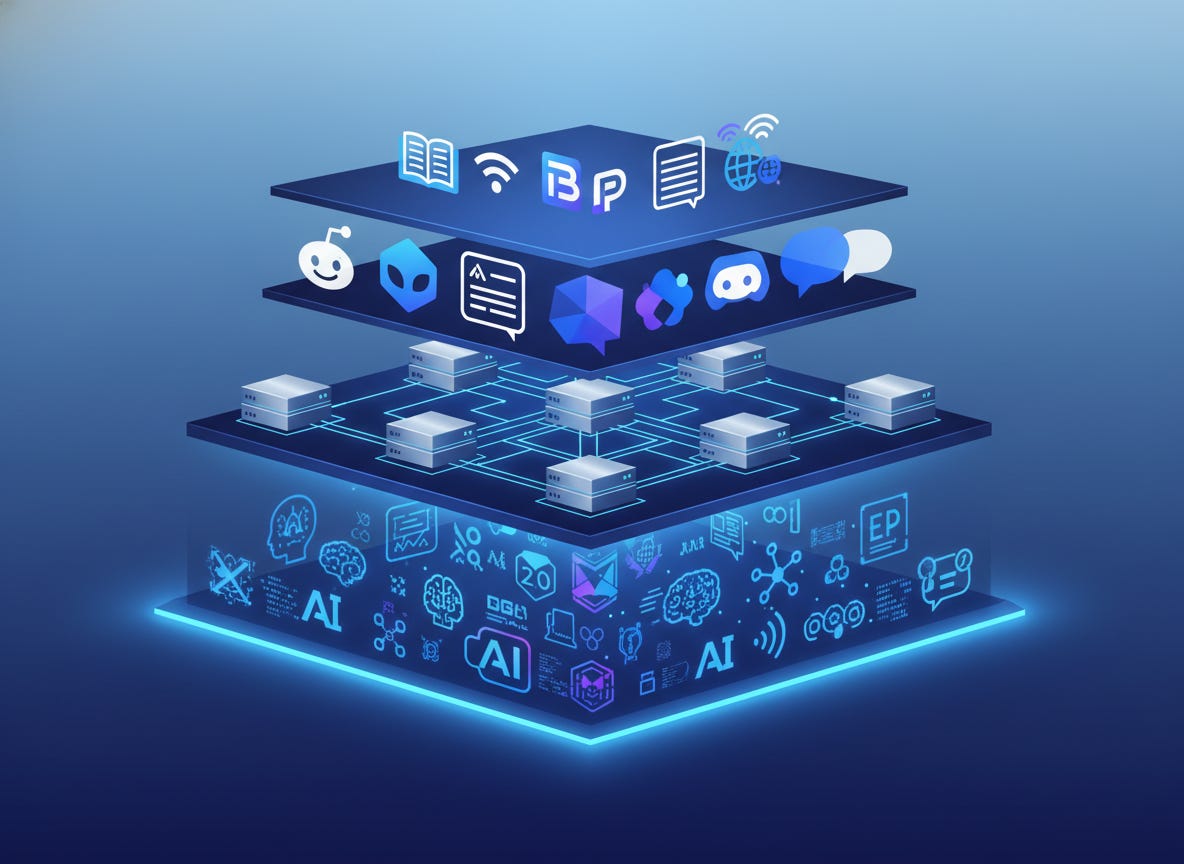
What’s replacing Stack Overflow isn’t a single platform. It’s a layered ecosystem.
Layer 1: LLMs for basic questions. “How do I parse JSON in Python?” Don’t post that anywhere—just ask Claude. Faster response, no judgment, no risk of being marked as a duplicate. Eighty-four percent of developers now use AI tools. For basic technical questions, this is often faster and lower-friction than posting ever was.
Layer 2: MCP servers for executable knowledge. This is the part most people haven’t caught up to yet. The Model Context Protocol ecosystem has exploded to 17,000+ servers, with backing from the Linux Foundation and adoption by major players. These aren’t just answers—they’re capabilities. Instead of reading how to do something, you get a tool that does it. Knowledge that executes.
Layer 3: Communities for discussion. Reddit, Discord, Dev.to. When you need opinions, validation, or to talk through a problem with humans who’ve been there, this is where you go. LLMs can tell you how to use a library; humans tell you whether you should.
Layer 4: Deep expertise for analysis. Blogs, Substacks, video courses, conference talks. Long-form content that explores ideas in depth, with personality and opinion. This is where the experienced practitioners share hard-won knowledge that doesn’t fit a Q&A format.
Here’s what my workflow looks like now: basic syntax question → Claude. Need to connect to an API → MCP server. “Is this the right architectural approach?” → Reddit or Discord. Deep dive on tradeoffs → find a practitioner’s blog post.
This architecture is more sophisticated than Stack Overflow ever was. It’s specialized, distributed, and each layer does what it’s good at. The Q&A site tried to be everything; the new ecosystem lets each component excel at its purpose.
The counter-arguments
Fair criticism exists. Let me address it directly.
“Knowledge is fragmented now.” True. Your answer might be on Reddit, Discord, a GitHub issue, a blog post, or an MCP server. That’s friction Stack Overflow didn’t have. But this is the story of the entire internet—from centralized portals to distributed everything. We adapted before; we’ll adapt again.
“We’re losing archival permanence.” Discord conversations disappear. Reddit threads get buried. The 24 million Stack Overflow Q&As were searchable and permanent. This is a real loss. But the community that created those answers was already gone. The archive remains; the contribution stopped years ago.
“Developers are talking differently, not more.” Probably fair. I can’t prove total knowledge exchange increased. What I can show is that multiple platforms are thriving while Stack Overflow collapses. The activity went somewhere.
“Quality control without voting?” Reddit has karma. Discord servers have curation. LLMs let you iterate until you get a useful answer. None of these are perfect, but neither was Stack Overflow’s system—which surfaced answers based on who posted first and had the most reputation.
The bigger picture
Stack Overflow was a toll booth on the highway of developer knowledge. For a decade, if you wanted an answer to a programming question, you went through the booth. You tolerated the closure votes, the duplicate flags, the reputation games, because there wasn’t a better alternative.
LLMs removed the toll booth.
Developers didn’t stop traveling. They stopped paying.
What we’re witnessing isn’t the death of developer communication. It’s the unbundling of a monopoly. Stack Overflow tried to be the single source of truth for all technical questions. That model was always fragile—it just took a sufficient technological shock to reveal it.
The new ecosystem is messier. More distributed. Harder to search—though agentic coding infrastructure is changing that quickly. (I’d argue you could learn nearly as much from my mcp-skillset as from Stack Overflow. Better organized, semantic search, also built from community contributions. Without the BS.) But it’s also more human, more specialized, and better matched to how people actually learn and communicate.
The sentiment shift
One last data point. The 2025 Stack Overflow Developer Survey showed 84% of developers using AI tools—but sentiment was mixed. Only 60% viewed AI positively, down from over 70%. Forty-six percent actively distrusted AI accuracy.
That was 2025. Since then, models like Claude Opus 4.5 have made the generative AI question moot. The accuracy concerns that fed developer skepticism are evaporating. When an AI tool can reliably write, debug, and ship production code, the “will I use this?” question becomes “how do I use this effectively?”
The holdouts are running out of reasons to hold out.
Stack Overflow’s collapse isn’t a tragedy. A platform that optimized for definitive answers got replaced by tools that provide them faster. The discussion, community, and deep expertise went elsewhere—to platforms that were better at providing those things all along.
Good riddance. The future is tools for answers and humans for judgment.
I’m Bob Matsuoka, writing about agentic coding and AI-powered development at HyperDev. For more on how AI is reshaping developer tools, read my analysis of Your IDE Is a Comfort Blanket or The Age of the CLI. Hat tip to Alex Zoghlin for sharing Peter Coy’s article.
Where is LLM going to get it's future training data from if nobody is contributing to Stack Overflow? :-)