



You’ve probably heard the Luddite story. Fearful workers smashed machines because they couldn’t adapt to progress. Technology won. The end. It’s become shorthand for irrational resistance to change—”don’t be a Luddite” means “get with the program.”
The actual history is weirder and more useful.
Lyon, France was the silk capital of Europe. By 1812, over 11,000 Jacquard looms operated there—each one capable of weaving complex patterns that previously required a master weaver and an assistant working together for days. Half the city’s population worked in silk. The technology spread. Within decades, mechanized weaving transformed the textile industry across Europe. Britain’s handloom weavers—240,000 strong in 1820—collapsed to 3,000 by 1862. Wages fell 85% over 30 years. Master craftsmen went from 33 shillings weekly down to 5.
The Luddites weren’t ignorant. They weren’t even against progress. Historian Kevin Binfield puts it plainly: they wanted machines run by trained workers earning decent wages. That was it. They smashed specific looms owned by manufacturers who paid substandard rates—and left identical machines untouched in the same building if the owner paid fairly.
They saw exactly what was coming. They were right about displacement. But here’s the part that gets left out of the parable: the weavers who tried to become better weavers got obliterated too. Skill wasn’t the issue. The winners came from adjacent positions—merchants, mechanics, financiers—not from the looms.
I’ve crawled down this rabbit hole because the pattern maps almost perfectly onto software engineering right now. Timeline’s compressed—maybe 10-15 years instead of 50. Displacement mechanism’s different. But the strategic playbook? Identical.
Who Actually Got Rich
Joseph Marie Jacquard invented the loom. Got a pension and royalties—decent money, not transformative wealth.
Here’s who made the real money.
Jean-Antoine Breton was a mechanic—a mécanicien—in Lyon. Jacquard’s original punch card mechanism had problems: unreliable, sales stalled. Breton fixed it in 1815, developed the chain drive system that made the whole thing actually work at scale. After Breton’s improvements, adoption exploded. The guy who made imperfect technology commercially viable captured more value than the inventor.
Then there were the Soyeux—about 1,400 bankers and silk merchants who sat at the top of Lyon’s economic pyramid. They didn’t weave anything. They controlled finance and distribution. Provided raw materials to weavers, commissioned patterns, sold the finished products throughout Europe. When Jacquard looms made complex patterns cheaper to produce, the Soyeux captured the margin expansion. The canuts (weavers) revolted in 1831. Over 600 casualties. Wages kept falling anyway.
The pattern: Jacquard invented it. Breton made it work. The Soyeux got rich.
The pattern suggests the biggest winners weren’t the inventor or the craftsmen—they were the people who controlled commercialization and distribution of what the technology produced.
Sam Altman isn’t an AI researcher. Neither is Dario Amodei. They’re the modern Soyeux—controlling distribution of what the technology produces. The researchers at DeepMind and Anthropic who built the actual models? They’re Jacquard. The engineers making these tools production-ready? They’re Breton.
The “Room and Power” Model
Here’s a piece of Industrial Revolution history that never makes the standard narrative.
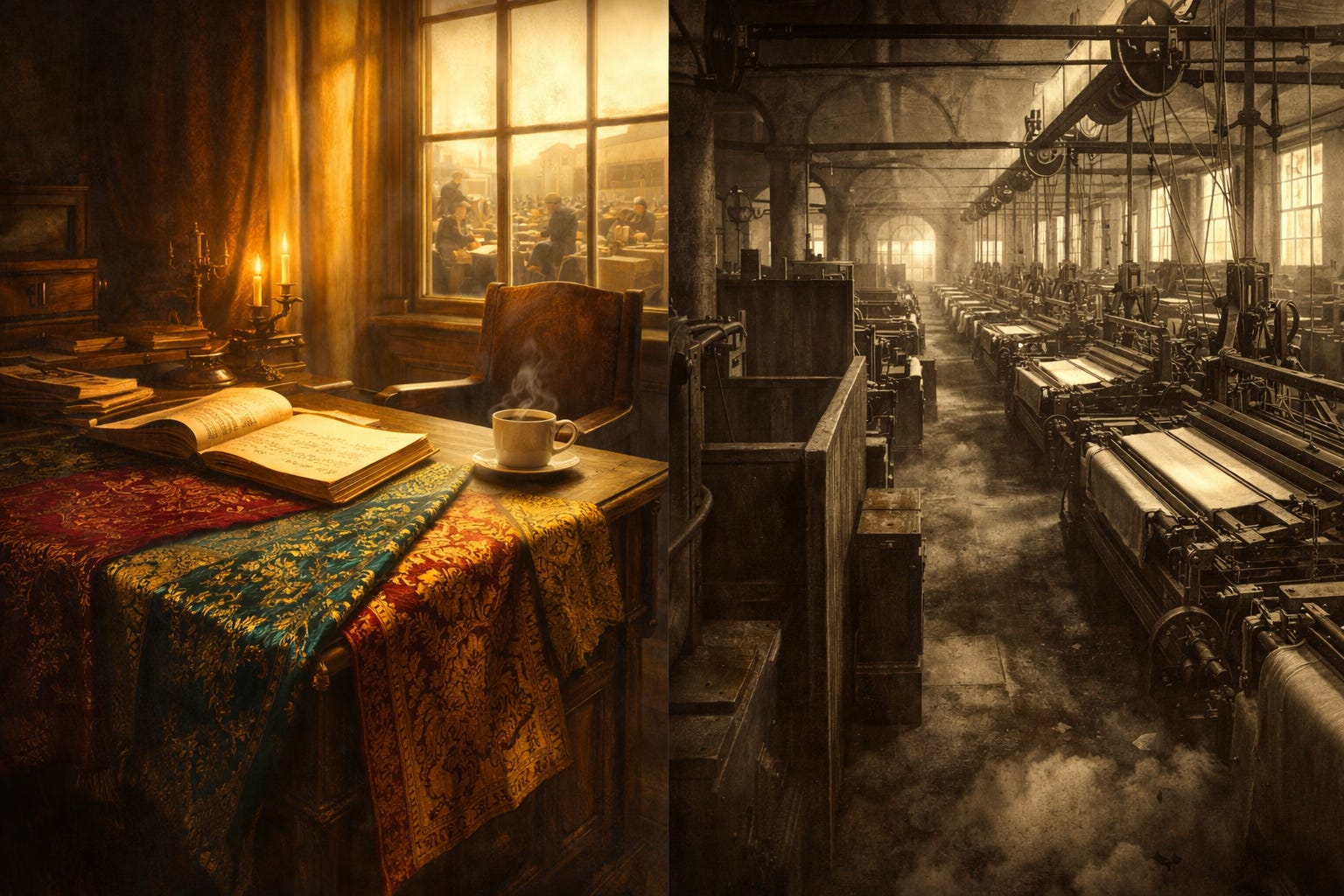
Mills in places like Nelson, England operated as “room and power mills, which let space to entrepreneurs.” Small business owners paid rent for space and access to steam power from the mill engine. No massive capital required. You rented capability.
70% of manufacturers in Nelson ran between 100 and 500 looms. Only three had more than 1,000.
Coworking space of the 1880s. API economy of the steam age. Small operators using shared infrastructure they didn’t have to build or own.
Modern version:
OpenAI API, Anthropic API, AWS Bedrock = renting “power” (access to foundation model compute you didn’t build)
Claude Code, Cursor, GitHub Copilot = tooling built on that power (IDE integration that makes the rental usable)
No-code platforms = even more abstracted rental (someone else handles the prompting too)
AI consulting market tells the story: $11 billion now, projected $91 billion by 2035 (Future Market Insights, August 2025). That’s 26% compound annual growth. Most of that goes to Accenture, Deloitte, McKinsey—but the growth rate signals opportunity at every scale. The “room and power” window opened when APIs made foundation models rentable.
New Markets the Jacquard Loom Created
The Jacquard loom didn’t just make patterned fabric cheaper. It created entire market categories that hadn’t existed.
Before: Patterned cloth was luxury goods. A master weaver and assistant might complete two square inches of highly patterned silk fabric over a full day. Aristocrats only.
After: Cost of fashionable patterned cloth cratered. Mass production. Middle class could suddenly buy what had been aristocratic luxury.
Market capture? No. Market creation.
What emerged:
Middle-class fashion as a consumer category (didn’t exist before)
Home furnishings at scale—upholstery, draperies, decorative fabrics
Fashion magazines and pattern publishing (Godey’s Lady’s Book hit 150,000 circulation)
Department stores (Bon Marché in Paris, 1852)
Interior decoration as an actual industry
Who captured this new demand?
Not the canuts operating the looms. The winners were fabric merchants like Barlow & Jones. Fashion magazine publishers. Department store founders. Pattern designers like Charles Frederick Worth, “father of haute couture.” People who spotted demand the technology enabled, built distribution channels, and created the taste infrastructure that shaped what consumers wanted.
They moved up the stack—from execution to taste-making, distribution, demand creation.
What about you? Are you competing in existing markets with AI efficiency? Or spotting new categories of demand that the technology makes possible?
The Skills Discontinuity
This is where it gets uncomfortable.
Skills that made someone an excellent handloom weaver—dexterity, patience, pattern knowledge, manual precision—didn’t help them become factory managers. The work was categorically different.
Same discontinuity is emerging in software engineering—the “vibe coding” phenomenon makes it visible.
Skills becoming less valuable:
Traditional Skill What’s Happening Syntactic mastery AI handles syntax perfectly API/library memorization AI has perfect recall Typing speed / raw output AI generates faster Boilerplate production AI’s strongest capability Pattern matching for common problems AI trained on all common patterns
Skills becoming more valuable:
Emerging Skill Why Architecture & system design AI can’t invent novel algorithms or architectures—it remixes existing approaches Problem decomposition Knowing what to ask AI to build Judgment / “taste” AI can’t judge what’s “good enough” for a human user Debugging AI output Someone has to catch the hallucinations Communication & requirements Prompt engineering is communication Responsibility / accountability AI doesn’t take responsibility for decisions
Here’s the data that matters: 32% of senior developers (10+ years experience) say over half their shipped code is AI-generated. For juniors (0-2 years)? Just 13% (Fastly Developer Survey, July 2025, n=791).
Seniors use AI more aggressively because they can evaluate and correct AI output. They spot when code “looks right” but isn’t.
Juniors who skip manual learning—who vibe-code their way through without building understanding—accumulate what one researcher calls “capability debt.” Demonstrating output while never developing the judgment that makes output valuable.
Stack Overflow survey: over 70% of developers use AI coding tools, but many junior developers feel less confident in their skills as a result. Struggle to pass interviews. Can’t debug legacy systems. Can’t climb into senior roles.
The skills that made great handloom weavers didn’t transfer to factory management. The skills that make great traditional coders won’t fully transfer to AI-augmented development.
Flip side though...skills that had nothing to do with traditional coding—clear communication, problem decomposition, architectural thinking, taste—suddenly matter a lot.
The Engels’ Pause
Between 1790 and 1840, Britain went through what economists call an “Engels’ Pause.” Output per worker rose 46%. Real wages? Up only 12%. Productivity gains flowed to capital owners. Workers saw almost nothing.
Took 50-80 years before wages rose with productivity. Required political reform (the 1832 Great Reform Act), worker organizing, gradual labor protections.
Signs we’re in one right now:
Philippines call centers: AI copilots raised productivity 30-50%, wages stagnated
U.S. from 2000-2017: average wages grew about $6,000 while GDP per worker nearly doubled
India’s IT sector: fresh grad hiring collapsed from 600,000 to 150,000 annually; 80,000 layoffs across major firms in 18 months
Expert predictions for 2025-2035 split hard:
Source Prediction Most economists 0.4-1.5%/year GDP growth from AI Most AI insiders 3-30%/year GDP growth Acemoglu (MIT, conservative) Only 1-1.6% GDP increase over decade McKinsey 30% of US work hours automated by 2030 WEF 75M jobs displaced, 97M created (net +22M) Goldman Sachs 15% labor productivity increase when fully adopted
Why do economists and AI people disagree so wildly? The disagreement is about AI capabilities progress, not economics. Economists mostly treat AI as a one-time shock. AI insiders expect continued capability improvement.
Here’s the reality check though. MIT’s Project NANDA published “The GenAI Divide: State of AI in Business 2025” in July 2025, analyzing 300 public AI deployments and interviewing 150 leaders. Their finding: only 5% of AI pilots delivered measurable P&L impact. Technology exists. Implementation friction? Massive.
(Worth noting: that 5% figure specifically measures direct revenue impact—critics point out it excludes efficiency gains and other benefits. Still, the gap between AI spending and business returns is real.)
My read on the next decade:
Displacement slower than AI enthusiasts predict. Comparison isn’t to AI capability but to organizational ability to deploy AI capability. Much harder problem.
The Engels’ Pause is already underway. Productivity gains visible. Wage gains aren’t. AI makes work more productive, gains accrue to capital, workers see stagnation.
Skills discontinuity creates the displacement. Not “AI replaces developer” but “developer-who-uses-AI-well replaces 3-5 developers-who-don’t.”
The “room and power” window is now. Small operators using shared AI infrastructure can compete with larger players—for maybe another decade. Window closes when infrastructure commoditizes and differentiation shifts elsewhere.
New market creation is where real wealth will accumulate. Finding the equivalents of “middle-class fashion” and “fashion magazines.” Categories that didn’t exist before the technology.

What to Actually Do About This
The handloom weavers who survived did one of three things:
Became factory operators — rare, most lacked capital and skills
Moved into adjacent industries — pattern design, fabric retail, machinery maintenance
Specialized in niches machines couldn’t reach — bespoke work, repair, artistic pieces
For software engineers right now, same playbook.
Stop Competing on Execution Speed
AI will always be faster at boilerplate. Always. Common patterns, CRUD operations, glue code. If your value proposition is “I write code quickly,” you’re competing with something that improves exponentially.
Move Up the Stack
For engineers, “up the stack” means:
Architecture and system design — AI can’t design systems that scale, handle edge cases gracefully, balance technical and business constraints. It remixes existing architectures. Original design requires understanding trade-offs it’s never seen.
Problem identification — Knowing what to build matters more than how. Requirements gathering. Stakeholder translation. Understanding which problems are worth solving.
Quality judgment — Spotting when AI output is subtly wrong in ways that won’t surface until production.
Cross-functional communication — Technical-to-business translation. The stuff that happens in meetings, not in code editors.
Build Judgment, Not Just Output
Vibe coding research is unambiguous. Developers who skip manual learning never develop intuition to evaluate AI output.
This doesn’t mean reject AI tools—it means:
Practice without AI regularly — maintain ability to solve problems from scratch
Use testing, linting, and architectural analysis to verify AI output meets your standards
Understand why solutions work, not just that they work
Build debugging skills that catch hallucinations
That’s why seniors ship more AI code than juniors. They use AI more aggressively because they can evaluate it. That judgment came from years of writing code manually. No shortcut.
Find the “Room and Power” Opportunities
What do you know that AI doesn’t? What industries do you understand from the inside? What problems have you seen firsthand?
Same model as 1880s Nelson:
Pick a domain you understand deeply
Rent AI capability through APIs
Apply domain expertise to problems that need context AI doesn’t have
Look for Market Creation
New categories AI might enable? AI-native education at scale. Content industries we can’t name yet. “Taste arbitrage” services — helping people know what to build with AI capability.
Competing in existing markets with AI efficiency? Race to the bottom. Everyone gets the same AI. Creating new categories is where transformative value accumulates.
Bottom Line
The 50-year transition that destroyed Britain’s handloom weavers is compressing into 10-15 years for knowledge workers. Skilled craftsmen watch expertise get automated. Wages stagnate while productivity rises. Winners understand commercialization and distribution rather than craft.
Choice is yours.
Perfect your syntax. Memorize more APIs. Crank out more lines of code. Compete on execution speed. The canuts tried that strategy. Revolted twice. Still lost.
Or recognize the skills that made you valuable are getting commoditized. The skills that matter going forward are different. Architecture. Judgment. Problem identification. Domain expertise. Ability to evaluate AI output rather than just generate it.
The modern Soyeux—the Altmans and Amodeis controlling AI distribution—are already emerging. The “room and power” window is open now.
Question isn’t whether AI will change software engineering—it already has.
Question is whether you’ll be a canut trying to weave faster, or someone who figured out what actually creates value in the new economy.
History suggests the answer matters quite a bit.
More on agentic development and the tools reshaping software engineering at HyperDev.
I was in Lyon a couple of years ago and highly recommend these attractions:
Musée de l’Imprimerie et de la Communication Graphique (Museum of Printing and Graphic Communication) - this is Lyon’s book/paper printing museum, covers Gutenberg through modern graphic design
Brochier Soieries - one of the Jacquard success stories. Didn’t compete on weaving speed, moved into niches machines couldn’t reach (haute couture relationships, artist collaborations), found new markets the technology enabled (aerospace textiles), and kept adapting. The last workshop in France still doing traditional “printing à la lyonnaise” by hand—but they’re also doing optical fiber fabrics. They have a showroom of Jacquard prints and an active workshop.