


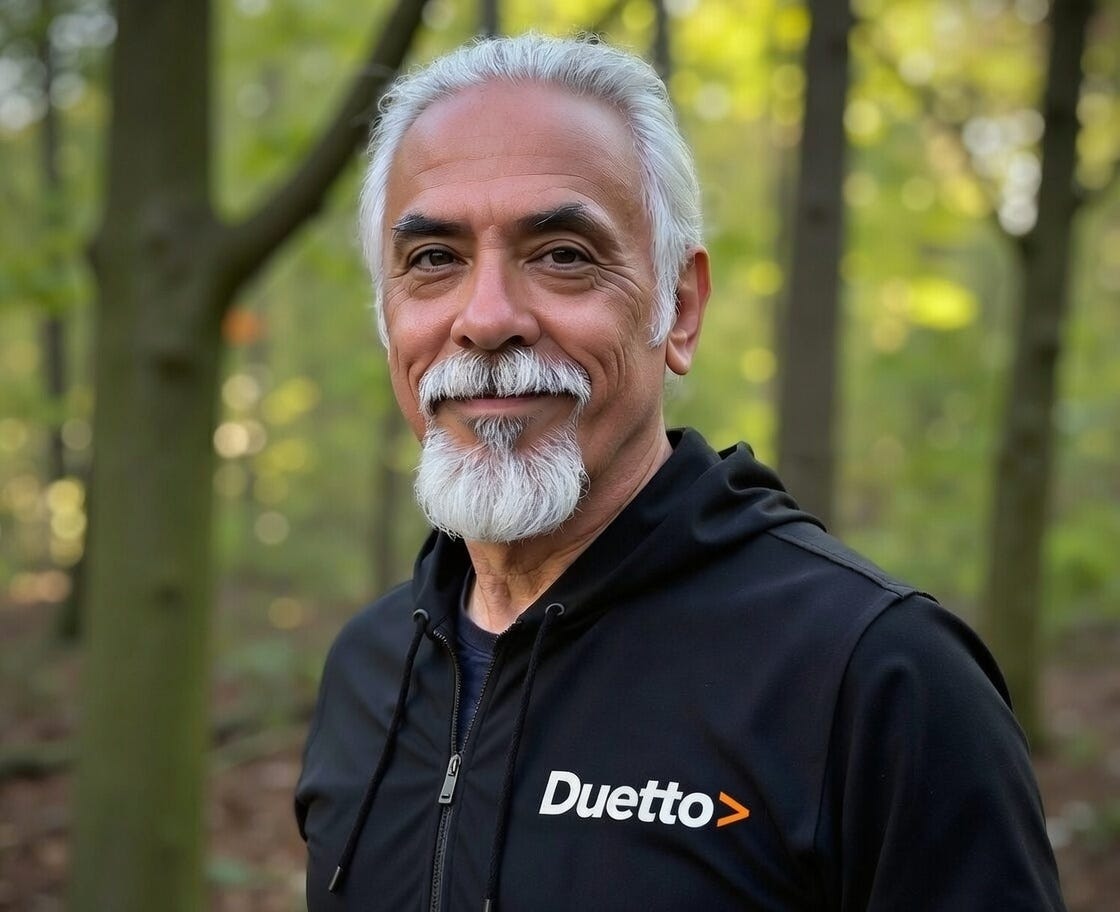
I’m starting with Duetto as Chief Technology Officer on Monday.
After a year of writing about agentic AI, building open-source tools, and consulting with organizations on AI-powered development, I’m stepping into a full-time leadership role at a company positioned at the intersection of everything I’ve been thinking about: ML-driven decision systems, enterprise transformation, and the practical application of AI to real business problems.
This feels like the right move at the right time. Let me explain why.
What I Learned As A Solo Practitioner
The past year has been an education. After not having seriously coded for decades as the CTO of both small and large organizations, I’ve transformed to a practitioner: building orchestration frameworks, stress-tested the current crop of AI coding tools, and documented what actually works versus what vendors promise. I’ve consulted with other CTO and engineering leaders navigating their own AI adoption journeys and helped small teams implement the patterns I’ve been writing about.
Here’s what is clear: the patterns work. The productivity gains are real—not the 10x hype, but meaningful improvements in how individuals and small teams ship software. My frameworks for multi-agent orchestration, specification-driven development, and human-AI collaboration have proven themselves in production environments.
And now it’s time to move to a different playing field — back to being a CTO, but now armed with tools I couldn’t have imagined a year ago.
As a solo practitioner and fractional advisor, I could demonstrate these patterns. I could help teams adopt them. The next challenge is proving them at enterprise scale—building the organizational structures, developing the team dynamics, and creating the systematic approaches that make AI-augmented development sustainable across an entire engineering organization.
The real test isn’t whether one developer can be more productive with AI. It’s whether an entire engineering organization can transform how it builds software while maintaining quality, security, and velocity. That requires being inside an organization, not advising from the outside.
Why Duetto?
I looked at a lot of opportunities over the year. My criteria were specific:
Right size. Large enough to have real engineering challenges and meaningful scale, small enough that a CTO can actually shape culture and direction. Duetto has 200-350 employees serving 7,200+ properties globally—substantial but not bureaucratic.
Right ownership. GrowthCurve Capital acquired Duetto in June 2024 with an explicit investment thesis around AI and data analytics. Their portfolio focus and the capital they’re willing to deploy signal serious commitment to technical transformation, not just financial engineering.
Right leadership. Alex Zoghlin joined as CEO in June 2025 with a track record I respect—co-founder and CTO of Orbitz, head of strategy and technology at Hyatt, CEO of ATPCO. He understands both travel technology and enterprise transformation. More importantly, my conversations with Alex have impressed me with his technical acumen and genuine openness to new ideas. That combination—deep experience, technical knowledge, and intellectual curiosity—is very rare in CEOs.
Right domain. Revenue and profit optimization will be transformed by ML and LLMs in ways most people haven’t fully grasped. Duetto’s core business — dynamic pricing, demand forecasting, yield management — is fundamentally algorithmic. The company already makes over a million pricing decisions daily across its platform. The opportunity to enhance those systems with modern AI/ML approaches is enormous.
Right team. I’ve met with Growth Curve, the Duetto leadership team, and individual contributors. What I found was enthusiasm, technical competence, and genuine interest in evolving how they work. No organization is perfect, but the cultural foundation is solid.
The Transformation Opportunity
Here’s my thesis: we’re at an inflection point where AI doesn’t just help individuals code faster—it enables entirely different organizational structures for building software.
The traditional model assumes engineering productivity scales linearly with headcount, minus coordination overhead. Add 10 engineers, get roughly 8 engineers worth of output after accounting for meetings, alignment, and communication complexity. This is why Brooks’s Law has held for decades.
AI-augmented development changes the equation. Not uniformly—the 10x productivity claims are mostly marketing. But for specific types of work, with the right tooling and workflows, individual contributors can genuinely achieve 3-5x productivity on substantial portions of their work. More importantly, the nature of what requires human judgment versus what can be delegated to AI systems is shifting rapidly.
This creates an opportunity to rethink team structures. Not replacing engineers with AI, but redesigning how engineering organizations operate when individuals have dramatically more leverage on certain tasks. What does a product team look like when specification and architecture work becomes the primary human contribution? How do you structure code review when AI generates most of the implementation? What skills matter for senior engineers when junior tasks are increasingly automated?
I don’t have complete answers. Nobody does—we’re all figuring this out in real time. But Duetto offers something rare: a company with technical leadership willing to experiment, ownership willing to invest, a domain where the results are measurable, and enough scale to validate whether these organizational patterns actually work.
Why Hospitality Revenue Management Matters
Some readers might wonder why I’m excited about hotel pricing software. Fair question. I love travel and hospitality. It’s been my home for nearly two decades. I’m eager to jump back into it. It’s also an industry crying out for technical innovation, as I’ve written about before.
Revenue management is one of the purest applications of ML in enterprise software. The problems are well-defined: given demand signals, competitive data, historical patterns, and capacity constraints, optimize pricing to maximize revenue (or increasingly, profit). The feedback loops are tight—you can measure whether your pricing decisions worked within days. The data is rich and structured.
This is exactly the kind of domain where AI advances will compound. Better demand forecasting. More sophisticated segmentation. Real-time competitive response. Natural language interfaces for revenue managers. Eventually, increasingly autonomous systems that can execute pricing strategies without constant human oversight.
Duetto has been at the forefront of this space for over a decade—they pioneered “Open Pricing” as an alternative to traditional rate management, and they’ve consistently ranked #1 in their category. But the technology landscape is shifting faster than most incumbents can adapt. The opportunity is to accelerate Duetto’s AI capabilities while the company is still nimble enough to move quickly.
The recent acquisitions—MiceRate for function space optimization, HotStats for profitability benchmarking—expand the platform’s scope beyond room pricing to total revenue and profit management. The technical integration work alone is substantial, but the strategic opportunity is larger: building an AI-native platform that helps hospitality operators optimize their entire business, not just room rates.
What This Means For HyperDev
I’m not stopping.
Writing has become essential to how I think. The discipline of articulating ideas clearly, testing them against reader feedback, and building in public has shaped my understanding of this space more than any other practice. Giving that up would be a mistake.
That said, expect changes.
Velocity will decrease. I’ve been publishing 2-3 substantial pieces weekly. That pace isn’t sustainable with a full-time role. I’ll aim for weekly publication, possibly bi-weekly during intense periods.
Perspective will shift. I’ll have less time for comprehensive tool reviews and market surveys. I’ll have more insight into enterprise-scale AI adoption, team transformation, and the practical challenges of implementing these ideas in production environments.
Some topics will be off-limits. I won’t write about Duetto’s competitive positioning, proprietary technology, or internal challenges. I will write about generalizable patterns, industry trends, and lessons that benefit the broader community without compromising my employer.
The community matters more than ever. As my publishing frequency decreases, I’ll rely more on reader questions, feedback, and topic suggestions to prioritize what I write about. If you have specific areas you want me to explore, let me know.
What I’m Looking Forward To
Honestly? Building something substantial from an organizational perspective again. I’m proud of what I’ve done practitioner-wise and with my startups, but moving organizations are a different type of challenge.
Consulting and writing are intellectually stimulating but emotionally incomplete. You influence outcomes without owning them. You advise on decisions without living with their consequences. You observe transformation without being transformed yourself.
I miss the weight of real responsibility—the 3 AM production incidents, the hard conversations about priorities, the satisfaction of shipping something that matters to customers. I miss building teams, mentoring engineers, and creating environments where people do their best work.
I also miss being proven wrong in ways that matter. When you’re an outside advisor, you can always claim your recommendations would have worked if only they’d been implemented properly. When you’re the CTO, you own the outcomes. That accountability is uncomfortable and essential.
Duetto offers the chance to test everything I’ve been writing about. If AI-augmented development can transform an engineering organization, I should be able to demonstrate it. If the productivity patterns work at scale, they should show up in our velocity and quality metrics. If the organizational structures I’ve theorized about are viable, I need to build them and see what happens.
This is the job. I’m ready.
Timeline and Transition
I start on Monday.
Expect the rhythm to change. I’ll still be here, still thinking through these problems in public, still learning from this community. Just with different constraints and, I hope, deeper insights to share.
Thank you for reading, for the conversations, and for making this publication worth writing. The next chapter should be interesting.
I’m Bob Matsuoka, writing about agentic coding and AI-powered development at HyperDev. For context on the AI development patterns I’ll be bringing to Duetto, read my analysis of multi-agent orchestration in practice or my deep dive into the evolution of agentic AI coding tools.
Fascinating. It's incredibily inspiring to see your practical, reall-world experience with agentic AI and multi-agent orchestration translating into such a powerful leadership position. What if scaling those proven human-AI collaboration frameworks, which you demonstrated in production, could completely redefine how large organizations approach enterprise transformation, not just in software delivery but across every decision system?
Congrats Robert!