

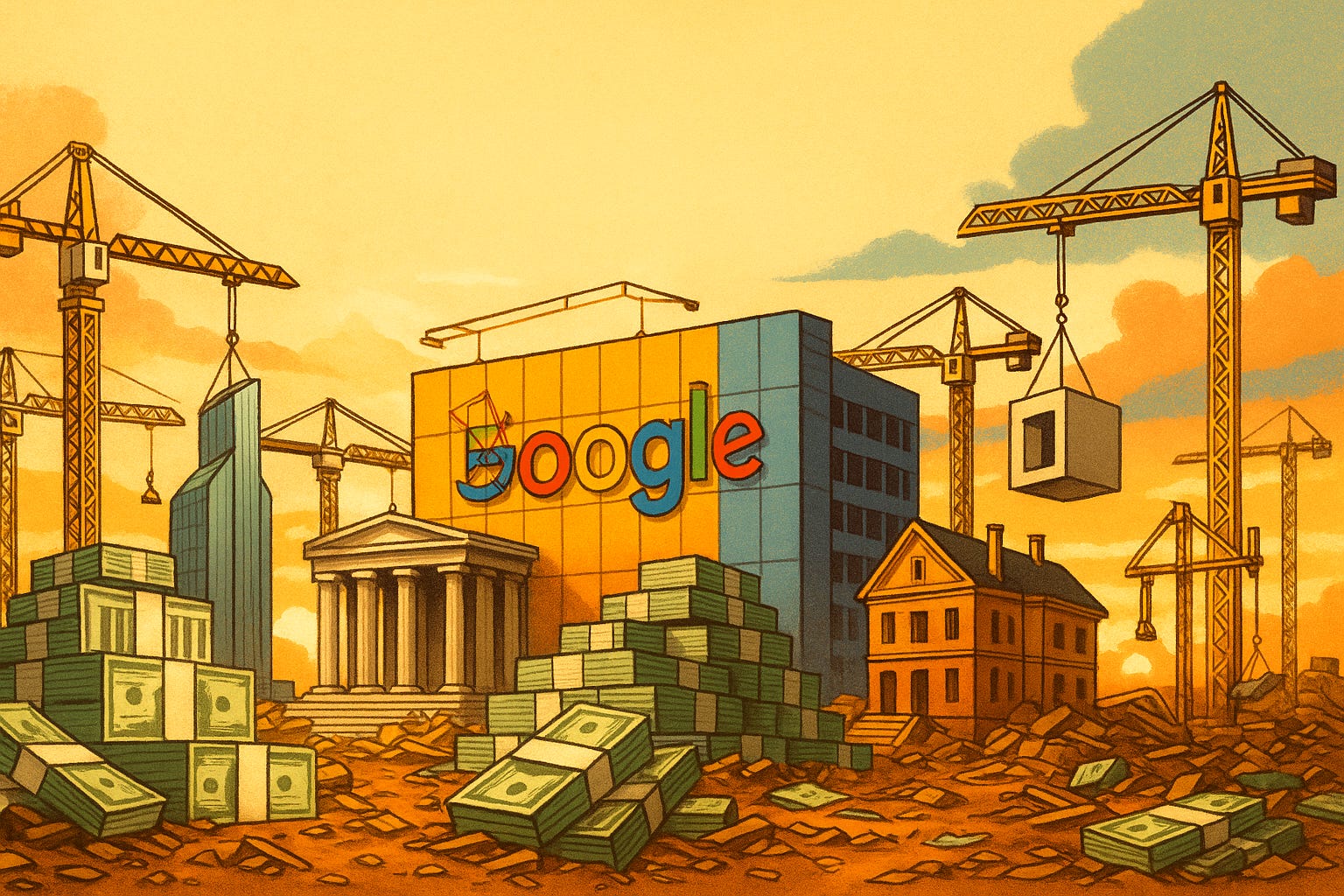
Google invested in Cursor on November 13, 2025. Five days later, they launched Antigravity as a direct competitor.
Let that sink in for a second.
The company that reportedly spent $2.4 billion acquiring Windsurf’s top talent (after OpenAI’s acquisition attempt collapsed in July 2025) decided the best strategy was to simultaneously bet on their rival and build their own version. This isn’t innovation—it’s expensive insurance against being excluded from the AI coding revolution they should’ve led.
I spent about 30 minutes watching Antigravity try to debug an import script that had nothing to do with what I’d asked it to do. It found an error through linting or typing, decided that was the most important thing in the world, and wouldn’t let it go. If I were getting paid to write comprehensive reviews, I’d probably reset and try again. But honestly? I didn’t want to spend more time on what felt like Google throwing another product at the wall.
The talent raid that became a product
Here’s what actually happened. When OpenAI tried to acquire Windsurf for $3 billion in July 2025, Microsoft’s IP lawyers killed the deal over code ownership conflicts. According to industry reports, Google swooped in with a “reverse acquihire”—approximately $1.2 billion to investors and another $1.2 billion in compensation packages to grab CEO Varun Mohan, co-founder Douglas Chen, and their entire R&D team. Plus a nonexclusive license to Windsurf technology.
Four months later: Antigravity.
The architecture tells the story. It’s an Electron app forked from VS Code OSS—the same foundation as Cursor and the original Windsurf. Code analysis reveals references to “Cascade,” Windsurf’s agent system. Simon Willison called it correctly: “At first glance Antigravity is yet another VS Code fork Cursor clone.”
But he also found genuinely novel elements. The three-surface architecture—Agent Manager dashboard, traditional Editor, and deep Chrome browser integration—represents a notable departure from standard IDE patterns. Instead of AI embedded in the IDE sidebar, Antigravity makes the Manager View the primary interface for spawning and orchestrating agents. The editor becomes one tool agents use rather than your main workspace.
The browser automation is the clearest technical advance. Using Gemini 2.5 Computer Use model, agents can open Chrome, click elements, fill forms, capture screenshots, record video walkthroughs, and validate their own code. This integrated self-verification through browser testing doesn’t exist in Cursor, Claude Code, or GitHub Copilot.
That’s real innovation. I’ll give them that - it’s rare (for them) these days.
But when you’re CLI-first like me, an IDE with great browser debugging doesn’t move the needle. I have MCP browser tools. I’ve used Playwright. They’re always a pain, sure. But I’m not rewriting my entire development workflow to get better browser automation. (Also this article is more of a reflection on Google’s strategy than Antigravity per se. I’m sure at some point I’ll have an opportunity to take the browser testing features for a spin as I did with Codex-Max.)

When benchmarks meet reality
Gemini 3 Pro topped every major AI leaderboard on launch day under test conditions. 1501 Elo on LMArena (first model to cross 1500). 76.2% on SWE-bench Verified. 45.1% on ARC-AGI-2 with Deep Think mode. These are legitimate achievements, not marketing spin.
The technical specs are impressive too. 1 million token context window. Native multimodal processing through a unified transformer architecture. Dynamic reasoning depth controlled via a thinking_level parameter. Google’s sparse Mixture-of-Experts architecture, trained exclusively on TPUs.
But here’s where the marketing meets the road.
MIT Technology Review’s Ethan Mollick tested Gemini 3 on actual research work. His verdict: it performs “graduate-level work competently” but with “weaknesses of a grad student: statistical methods needed work, approaches weren’t always optimal, theorizing sometimes exceeded evidence.” Bottom line? It “still needs a manager who can guide and check it” rather than autonomous PhD-level operation.
Independent testing from Vals.ai found the official benchmark claims use optimized conditions—multiple attempts and rejection sampling—that don’t reflect typical performance. The model’s factual accuracy remains concerning: 72.1% on SimpleQA (straightforward questions) and an 88% hallucination rate when wrong per independent testing.
Field reports show rough edges that benchmarks miss. Developers who got Antigravity working love the speed when it works. One Reddit user solved a competitive programming problem in 5 minutes that takes humans 14-20 minutes. Android Authority published “I’m already impressed. Google wasn’t exaggerating about the improved reasoning and coding capabilities.”
But those praise posts get matched by frustration. “After 20 mins—oh no. Out of credits... switched back to cursor” became a common refrain on Reddit. The “generous rate limits” Google promised proved fictional in practice. Multiple users hit limits on their first serious attempt, with quotas refreshing every 5 hours based on undisclosed “work done” calculations.
VentureBeat captured the consensus: “Early Antigravity users have had mixed experiences, with many pointing to errors and slow generation.” Fast Company quoted users saying “Was much worse than GPT-5.1 for ‘find me research on [x]’-type queries. It kept trying to do my thinking for me.”
My 30-minute import script debugging session? That’s the product working as designed. Technically impressive under controlled conditions, practically frustrating in actual use.

The multi-agent marketing myth
Google’s “agent-first architecture” and “multi-agent workflows” marketing claims deserve special scrutiny. They represent the core differentiation narrative. But there’s a significant gap between what Google calls “multi-agent” and what computer science defines as multi-agent systems.
Google’s definition of “multi-agent” is task parallelization. That’s useful. But it’s not the cooperative agent orchestration seen in AutoGen or CrewAI or Claude-MPM.
Antigravity’s Manager Surface allows spawning multiple agent instances across workspaces. Each operates independently on its assigned task with no inter-agent communication, no role specialization, and no collaborative refinement. You can run multiple agents in parallel, but they don’t talk to each other, debate solutions, or refine through interaction.
True multi-agent systems like Microsoft’s AutoGen feature specialized agents with different roles (planner, coder, reviewer) conversing to improve solutions through debate. LangGraph provides graph-based state machines for deterministic agent coordination. CrewAI offers role-based teams with human-readable task assignments.
Antigravity provides none of these patterns.
The “multi-agent” capability is really multi-instance task parallelization—valuable for productivity but not an advance in orchestration science. Only the autonomy claim—agents operating across editor, terminal, and browser simultaneously—represents a meaningful integration advancement. Everything else is standard agent capabilities reframed through clever marketing.
Google’s fragmented portfolio problem
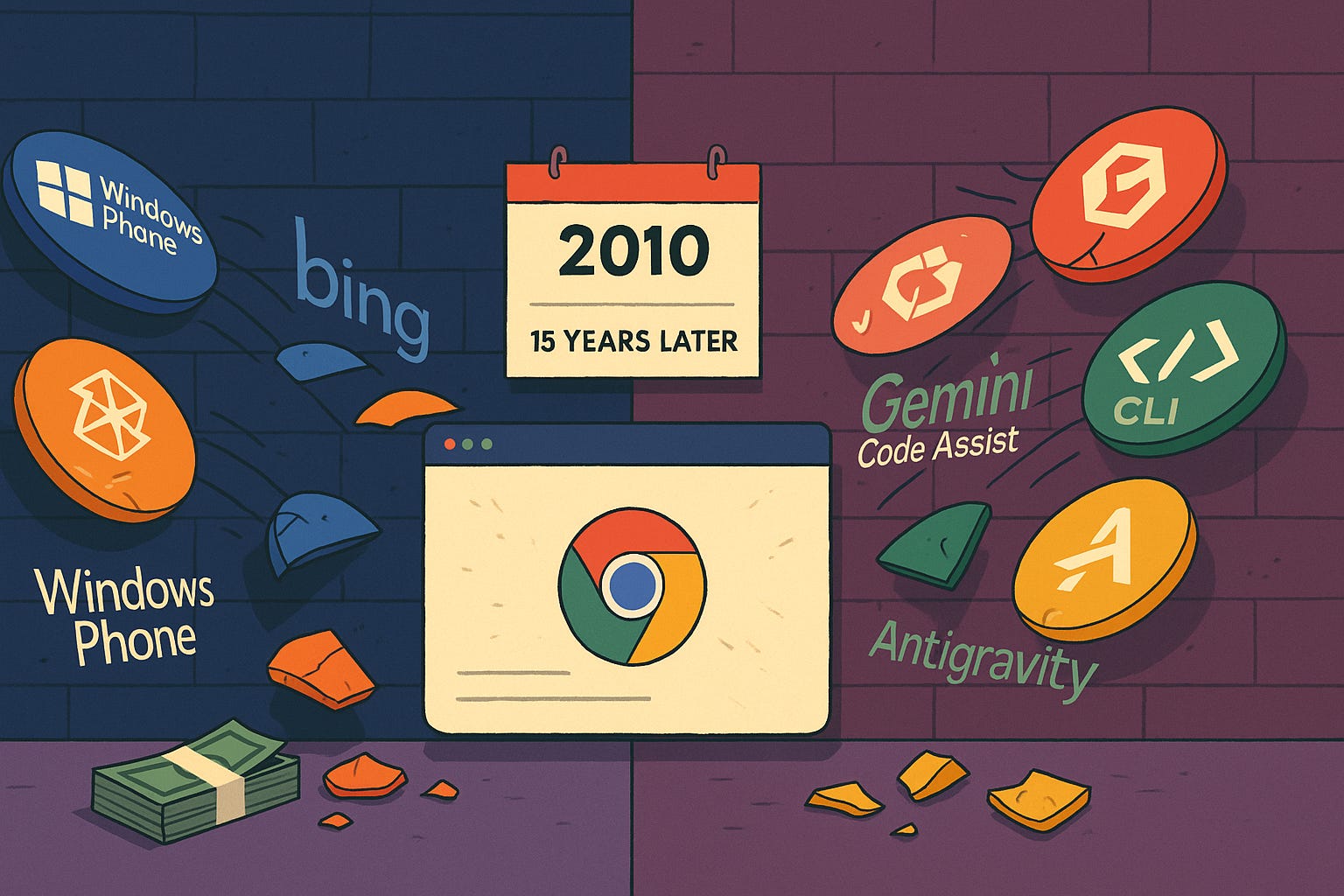
Some stats that make this launch revealing. Google now maintains:
Gemini Code Assist (IDE extensions)
Jules (asynchronous GitHub agent)
Gemini CLI (command-line tool)
Antigravity (standalone IDE)
Even Google’s own documentation struggles to explain when developers should use which tool. This fragmentation screams organizational silos rather than coherent vision. Different Google teams throwing multiple bets at the wall, none clearly differentiated.
We’ve seen this movie before. In 2010, Microsoft held 90%+ desktop market share but watched the iPhone and Android rewrite computing rules. Their response? Windows Phone, Bing with massive marketing spend, Azure, Windows Mobile, Zune. Multiple overlapping bets with no coherent vision. Steve Ballmer’s famous “developers, developers, developers” chant became emblematic of enterprise-first mentality while consumer innovation happened elsewhere. Forbes called him “the worst CEO of a large publicly traded American company” in 2012.
The parallel with Google 2025 is almost eerie. Dominant market position? Check. Multiple overlapping products with unclear differentiation? Check. Massive revenue from legacy business creating innovator’s dilemma? Check. In one informal Blind poll, 76% of respondents agreed “Sundar Pichai is Google’s Steve Ballmer.” Both business-focused CEOs following visionary founders, prioritizing financial metrics over platform transitions. (I’ve written before that I don’t consider the analogy perfectly apt.)
Microsoft eventually found its Satya Nadella and achieved a 10x stock increase. But that transformation took years and brutal honesty about past mistakes. Now it feels like Google’s playing defense, not building conviction.
Compare Google’s scattered approach to Cursor’s laser focus on a single refined experience reportedly generating over $1 billion in annual recurring revenue. Or Microsoft achieving 30% of code at Microsoft now AI-generated through deeply integrated Copilot (which may end up being an anti-pattern but the focus is impressive).
The market timing reveals urgency. Gemini 3 launched just seven months after Gemini 2.5 Pro—aggressive cadence driven by competitive pressure. OpenAI’s attempted $3 billion Windsurf acquisition, Anthropic’s Claude Code hitting $500 million run-rate, and Cursor’s explosive growth to majority Fortune 500 penetration all forced Google’s hand.
The real strategy: platform play, not IDE dominance
Google’s likely endgame isn’t capturing the IDE market. It’s making Gemini infrastructure essential across third-party IDEs (Cursor, JetBrains, GitHub) while using Antigravity to demo what Gemini can do. The simultaneous Cursor investment creates option value if Antigravity fails to gain traction.
This hedging strategy is rational. But it shows Google’s prioritized hedging over a single decisive vision.
They bought the Windsurf team. They invested in Cursor. They invested massively in Anthropic. They’re building their own tools. Fine.
For developers, the implication is clear. Try Antigravity (it’s free during preview) specifically for web development projects where integrated browser testing provides clear value. Use the Manager View for delegating complete features while working on other tasks—the task parallelization improves productivity when it works.
But keep Cursor or your current tool as primary driver until Antigravity proves reliable. The free tier’s severe rate limits mean this is an experimental supplement, not a production replacement.
For engineering teams? Wait 6-12 months before betting serious workloads on Antigravity. Use this period to negotiate better terms with Cursor and other vendors, leveraging Google’s entry for pricing pressure.
Bottom line
Gemini 3 shows genuine model advances particularly in multimodal understanding and abstract reasoning. Antigravity brings real architectural innovations in browser automation and task delegation UX. Both were released quickly, before reliability concerns were fully resolved.
The core problem isn’t technical capability—it’s strategic coherence. Google simultaneously invested in their competitor while launching a rival product, maintains a confusing portfolio of overlapping tools, and released products with stability issues under real-world conditions.
It feels like Google’s playing defense rather than executing a confident vision. The fragmentation weakens rather than strengthens Google’s position against focused competitors like Cursor, Anthropic, and Microsoft.
My initial skepticism was directionally correct. This is partially “VS Code with Google branding” via acquired Windsurf technology, catching up to competitors more than leaping ahead. But dismissing it entirely misses the browser automation innovation and Gemini 3’s benchmark leadership under test conditions.
The more accurate assessment? Real technical advances undermined by fragmented strategy and execution issues. Google can buy talent and build competitive products. Whether they can achieve the reliability and strategic clarity that Cursor has already demonstrated—and whether developers trust Google’s commitment enough to rebuild workflows around another Google experiment—that’s the question.
Whether Antigravity becomes a turning point or another addition to Google’s product graveyard (291 killed products and counting!) depends on execution in the next 12 months. The technology works when it works.
I just didn’t want to spend more time finding out how often that is.
I’m Bob Matsuoka, writing about agentic coding and AI-powered development at HyperDev. For more on the AI coding landscape, read my analysis of Claude Code’s agent coordination breakthrough or my deep dive into multi-agent orchestration systems.