



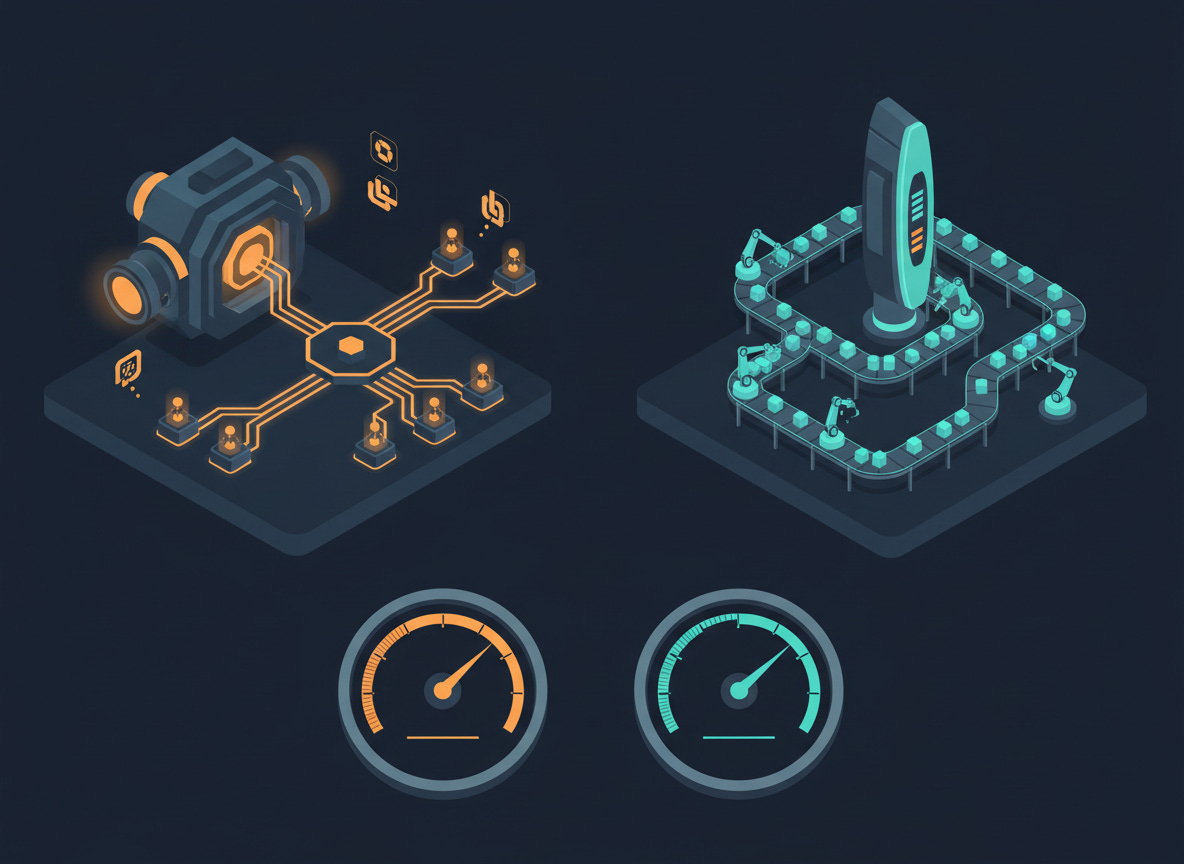
I treat Fable 5.2 as the model for complex work: project manager orchestration, hard code, and long research questions. Opus 5.5 takes the volume. On my fleet Fable runs about 1.5x per turn, writes more output tokens per turn, and its weekly meter empties first. So I spend it where the coordination or the problem is hard, and routine engineering, writing, and review stay on Opus.
These are my observations from running Fable 5.2 and Opus 5.5 on my own agent fleet. I asked a research agent to pull what the fleet has recorded since Fable 5.2 arrived. The numbers cover November 10 to the evening of November 15, from Claude Code transcripts on one machine. I counted model, usage fields, timestamps, and tool names.
Fable 5.2 on my fleet is mostly the Architect, the session that supervises the others. It produced 78% of Fable turns (14,969 of 19,071). The rest came from a handful of project manager sessions, plus 77 subagent turns. The engineers, critics, and research agents ran on Opus. For comparison, the Architect’s Opus turns come from November 1 to 9, before the switch.
What I Saw
Price and tokens. API list prices are $8 input and $40 output per million tokens for Fable 5.2, and $4 and $20 for Opus 5.5, per the Anthropic pricing page. That is 2x. A real session doesn’t pay 2x, because cache reads cost $0.20 per million on both models and make up 41% to 49% of the fleet’s list-priced usage. Cache writes run $10 against $5. Run the same tokens through both price lists and the Fable premium lands at 1.4x to 1.5x.
Fable also writes more. It produced 1.48x the output tokens per turn of Opus 5.5, in the Architect threads and the project manager threads alike. A turn is one assistant message. The pooled row in the table below reads 1.20x because Fable’s turns are mostly shorter Architect turns, while Opus’s are mostly longer project manager turns. Fable 5.2 defaults to high effort and Opus 5.5 to medium, per the effort docs.

Weighted at API list prices, that is 1.45x per turn overall and 1.68x for project managers.
Speed. Output speed is a tie, at a median of 100 tokens per second for Fable against 98 for Opus. Reply latency differs. On the project manager threads, median reply time was 9.1 seconds for Fable against 6.8 for Opus, and the 90th percentile was 26.2 against 15.5. Latency includes thinking time, and Fable writes more, so longer thinking and output explain part of the gap.
My replay study. I feed the same first-turn prompts to both models and score their interpretations against a rubric. The set is 49 scored pairs at medium effort, no tools, with one automated scorer (Sonnet 5.5). Fable averaged 8.61 out of 10 against 8.27. Fable won 20 pairs, Opus won 12, and 17 tied (sign test p=0.22).
The largest gap by dimension was in constraints (whether the model honored what it was told): 1.90 for Fable against 1.73, on a scale of 2 per dimension. That is in line with Anthropic’s note that Fable 5.2 “follows style rules closely”.
Published numbers, for context. Anthropic’s Fable 5.2 announcement (November 9) carries a same-run table against Opus 5.5. Scores are each model’s highest available effort unless noted.

The coding gap runs from effectively tied (45.3% vs 45.5%) to about eight percentage points depending on effort and benchmark. The biggest gaps sit on long, multi-step tasks. Anthropic’s guidance says to start with Opus 5.5 and move to Fable “if your evals at xhigh or max effort still fall short on demanding reasoning or long-horizon agentic work.”
How I’m Using Each
The research agent’s brief limited Fable to two jobs: reviewing pull requests before they merge, and research that runs many steps. I add project manager orchestration and hard code. My plan comes from where I see the hard problems. The widest published gaps are on long, multi-step tasks, which is what orchestration and research look like. The coding gap is smaller: effectively tied at High effort, 3.6 points at xhigh effort. So Fable gets the hard changes, where the gap opens, and Opus keeps the volume.
In practice:
Project manager orchestration. Fable when the session is coordinating many agents or holding a long plan. Routine project manager work stays on Opus. On the fleet, Fable project manager threads were slower at the median and cost about 1.7x per turn, so I pay that where the coordination is the hard part.
Code. Fable for the difficult changes, such as cross-cutting refactors and the problems Opus has already failed on. Opus for the steady volume. Opus ran 76,490 engineer subagent turns in these five days. That is the highest-volume work in the fleet, and it stays on the model that runs lighter per turn.
Research. Fable for questions that take many steps, and for anything where an Opus pass at xhigh effort fell short. Opus for the first pass.
Everything else. Opus. Writing, small edits, routine review, and anything cheap to redo.
The meter shapes the list. Fable’s weekly meter empties first, so “Fable for the complex work” is a short list. I already run a rule for the Architect that falls back to Opus when the Fable meter passes 90%, and I apply the same fallback to the rest. I pick the model at the start of a task, not partway through.
Fable 5.2 requires 30-day data retention and isn’t available under zero data retention unless Anthropic expressly authorizes it. Paths under a zero-data-retention agreement stay on Opus.
What I’m Logging Next
I’m logging the serving model on every task and every critic verdict, setting effort explicitly per role, and running a two-week matched trial of critic runs on the same pull requests. Two more replay runs are scheduled for November 17 and 24. The trial tests Fable as a critic. If its verdicts hold up against Opus’s on the same pull requests, it earns that work. If they don’t, review stays on Opus.
Bob Matsuoka is CTO of Duetto, a hospitality profit and revenue-management platform.
Related reading:
NEWS: Claude Fable 5.1 Lands, and the Docs Still Say Start With Opus 5 — Two small tests, run the day Fable 5.1 shipped.
FTT: Duetto’s Hackathon: What It Looks Like When the Model Flips — What changed when engineers worked in agentic loops.
We Need to Teach Delegation as an Engineering Skill — Giving another actor enough context and authority to do useful work.
AI Power Ranking — Comparisons and benchmarks for AI practitioners.